 705-998-2017
 vpm@visture.ca




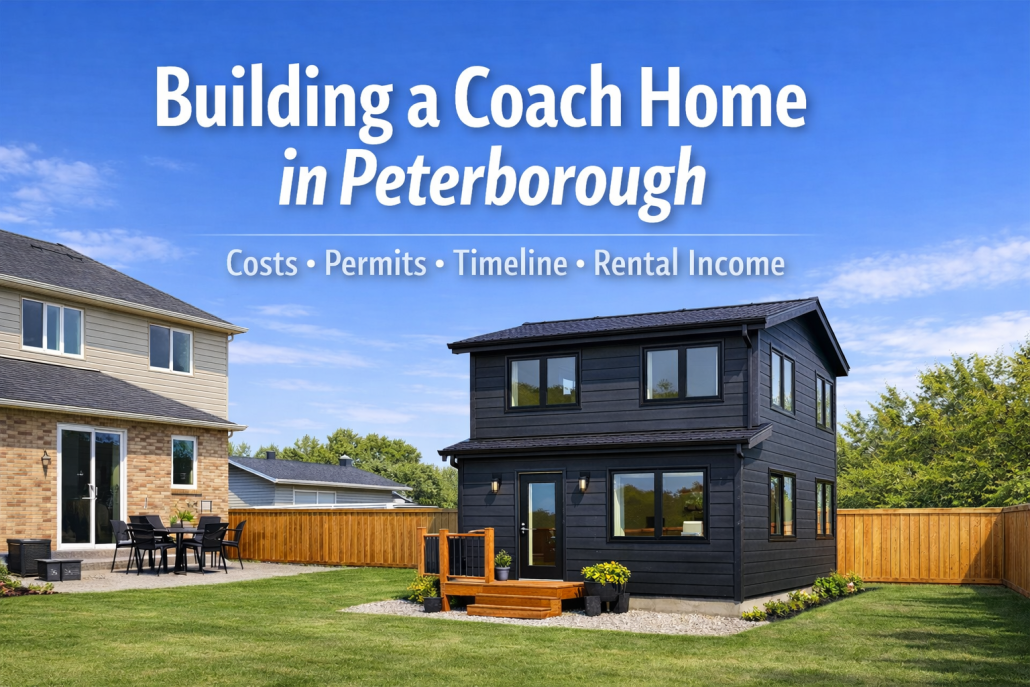
Building a Coach Home in Peterborough: Costs, Permits, Timelines, and How to Turn Your Backyard Into $2,200+/Month
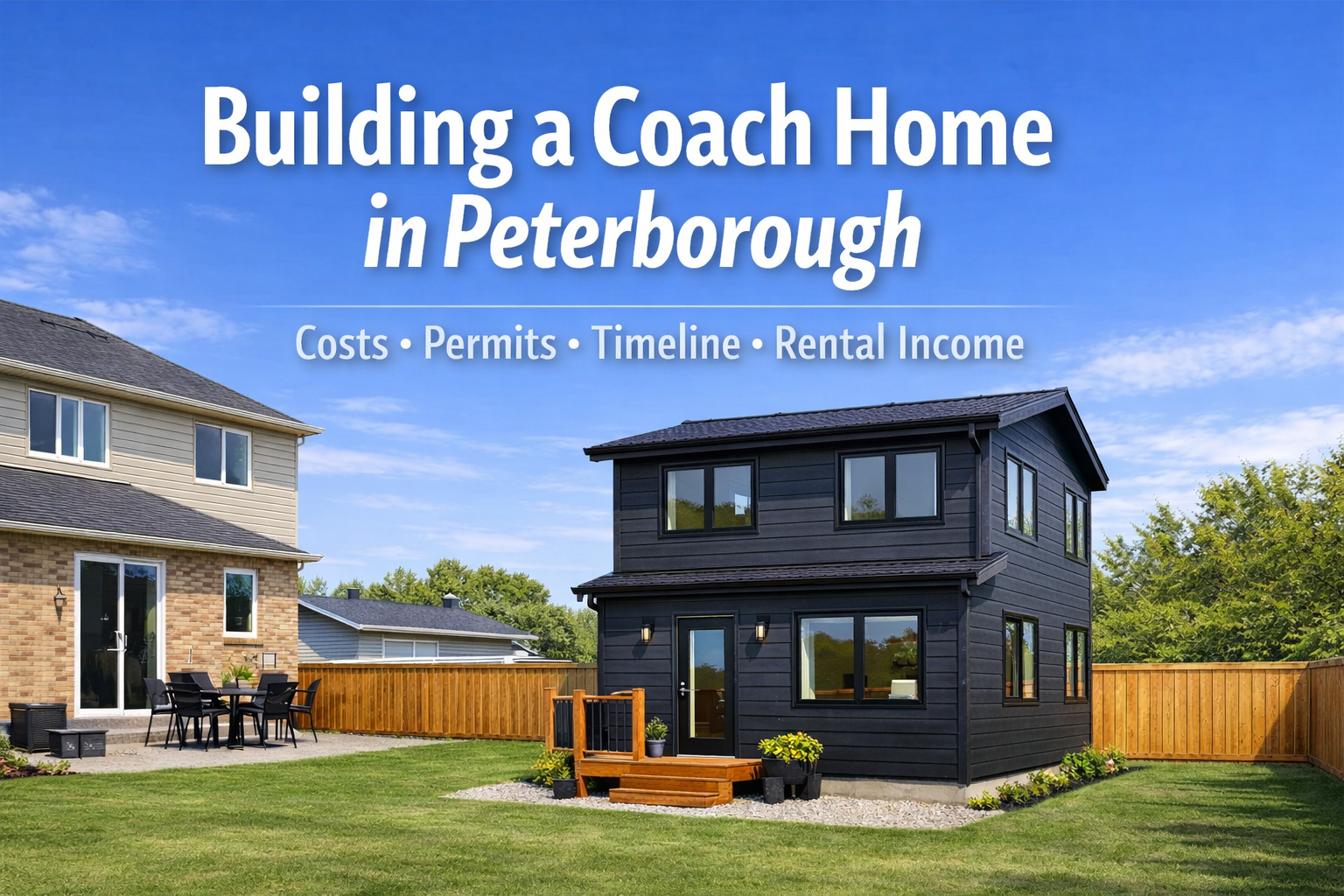
Building a Coach Home in Peterborough: Costs, Permits, Timelines, and How to Turn Your Backyard Into $2,000+/Month
Building a coach home in Peterborough is one of the clearest ways to add rental income to a property without taking on a separate investment purchase. But the numbers only work if you treat it like a real development project, not a backyard impulse build.
A detached coach home in Peterborough is usually treated as an Additional Residential Unit (ARU) by the City. Peterborough allows one ARU inside a permitted detached, semi-detached, or row house and up to one ARU in an accessory building on the same lot, or two ARUs inside the main dwelling. For detached ARUs, the City’s published rules include a minimum 1.2 m distance to the rear of the principal dwelling, 0.6 m from a side or rear lot line, a 4.3 m maximum height, and 10% maximum lot coverage for all accessory buildings combined. The unit also has to be serviced properly and cannot be in a floodway.
That matters because this is where a lot of Peterborough homeowners go wrong. They start with the rent number. They should start with lot fit, access, servicing, and permitability.
First, can you even build one?
Before you price out anything, you need to confirm the lot works.
For a detached coach home or backyard ADU in Peterborough, the City says the property must have a permitted principal dwelling in a residential zone, the ARU must be smaller than the floor area of the principal dwelling unit, it can have a maximum of 2 bedrooms, and it must connect to public water and wastewater unless private services are otherwise permitted for the main dwelling. Peterborough also requires a compliant access route. Exterior access has to be clear, stable, and at least 0.9 m wide, and firefighter access distances are capped unless an alternative solution is approved.
So the real first question is not “Can I make $2,200 a month?”
It is:
- Does the lot have enough rear yard depth?
- Can you maintain setbacks?
- Can you fit the unit and still stay within accessory building lot coverage?
- Is the path to the unit workable?
- Can servicing be brought to the backyard without ugly cost surprises?
- Will parking become a problem?
If the answer to two or three of those is shaky, the project can still work, but the margin gets thinner fast.
What does it cost to build a coach home in Peterborough in 2026?
This is the part people usually want simplified into one number. That usually leads to bad decisions.
For 2026, a realistic detached coach home or backyard ADU budget in Peterborough will often land somewhere around these bands:
- Small, efficient detached ADU: about $225,000 to $275,000
- Mid-range detached ADU with site work and better finishes: about $275,000 to $325,000
- Higher-spec custom build with more complex servicing or site constraints: $325,000+
That range is based on current Ontario garden suite and detached ADU market pricing published by industry sources, which place modular or prefab garden suites around $250,000 to $350,000 installed and more custom detached builds materially higher depending on design and site conditions. Those are not Peterborough-specific municipal figures, but they are in line with what Ontario detached backyard unit projects are costing in the current market.
For local hard permit math, Peterborough’s 2026 building permit fee schedule lists new residential construction at $29.45 per m² of gross floor area plus a $125 administrative fee, with a minimum fee of $235.
That is only one piece of the budget. Real project cost usually breaks down like this:
1) Design and drawings
You will usually need:
- site plan
- floor plans
- elevations
- cross-sections
- fire separation details
- HVAC/mechanical drawings
Peterborough’s ARU guide says drawings are to be prepared by a qualified professional such as an engineer, architect, or BCIN designer in the applicable cases.
2) Site work and servicing
This is the budget killer people miss.
Bringing water, sewer, hydro, and sometimes gas to a backyard unit can swing the project hard. Long trench runs, bad access, tree protection, grading issues, and drainage corrections are where “we thought this was a $280,000 build” turns into “why are we at $360,000 already?”
3) The building itself
This is framing, foundation, roofing, insulation, windows, doors, kitchen, bath, flooring, electrical, HVAC, and finish work.
4) Permit and municipal costs
That includes building permits and, depending on the structure of the project, potentially development-related charges.
Peterborough’s published 2026 city-wide development charges list residential charges at $68,604 per unit for “Residential A: Single and semi, 1 to 2 units” and $49,650 per unit for “Residential B: More than 2 units (e.g. row or garden suites),” plus area-specific charges. But do not assume that line item automatically applies in the same way to every backyard ARU scenario. Development charge treatment can vary depending on how the City classifies the project and what exemptions or rebate programs apply. This is exactly the kind of item you verify with the City before you commit.
If you want new rental income from your property, a coach home can be one of the strongest options in Peterborough, especially when development charges are waived in the right setup. Let Visture review your lot and show you what the numbers could look like.
5) Financing costs
If you are borrowing against equity, carrying interest during design, permit, and construction matters. A project that looks great on a rent calculator can look average once financing drag gets added back in.
Can you really turn your backyard into $2,200+/month in Peterborough?
Yes, but not automatically.
The “$2,200+/month” claim is realistic in Peterborough for the right detached coach home product, especially if it is:
- new
- self-contained
- well-finished
- in a solid neighbourhood
- has in-suite laundry
- has parking or strong walkability
- has private outdoor separation from the main house
For current market context, listings data sources show Peterborough rents around $1,677 for a 1-bedroom and roughly $1,900 to $2,200+ for the broader market depending on property type and date. CMHC’s October 2025 Peterborough rental data shows average apartment rents of $1,232 for a 1-bedroom, $1,513 for a 2-bedroom, and $1,736 for a 3-bedroom+ in the primary purpose-built rental market, while private market listing platforms are showing higher asking levels for newer product. That gap matters: a newly built detached backyard unit is not the same thing as an average older apartment stock number.
So in practice:
- a compact 1-bedroom detached ADU in Peterborough may rent below $2,000 if the finish level is basic or the location is weaker
- a sharper 1-bedroom or efficient 2-bedroom coach home in a good Peterborough area can push into the $2,200+ range
- product quality matters a lot because tenants compare new detached units differently than older apartment inventory
That is why build quality and layout matter. If you cheap out and produce a cramped backyard box, you cap rent and hurt the long-term value of the project.
Best Peterborough-area locations for coach home demand
From a local SEO and conversion angle, homeowners usually search this by area, not by planning term.
Common searches look more like:
- coach home Peterborough
- backyard suite Peterborough
- ADU builder Peterborough
- garden suite Peterborough
- secondary dwelling Peterborough
- coach house Lakefield
- backyard rental unit Bridgenorth
- detached ADU East City Peterborough
- in-law suite builder Selwyn
- legal backyard apartment Cavan Monaghan
In practical terms, strong demand tends to come from properties in and around:
- Peterborough
- East City
- North End Peterborough
- Old West End
- The Avenues
- Kawartha Heights
- Lansdowne corridor areas
- Lakefield
- Bridgenorth
- Selwyn
- Cavan-Monaghan
- Ennismore
- Millbrook
- Norwood
The reason is simple. These areas catch a mix of renters: hospital staff, Trent and Fleming-adjacent renters, downsizers, separated households, single professionals, couples priced out of buying, and families needing flexible multigenerational options.
What permits do you need in Peterborough?
At minimum, you should assume you need a building permit and a fully compliant set of supporting documents.
Peterborough’s ARU guidance says permit submissions for additional residential units go through the online portal and generally require proposed floor layouts, cross-sections, wall and ceiling fire-separation details, elevations showing the ARU entrance and egress window, and HVAC/mechanical drawings.
If you are building a detached coach home in Peterborough, the permit path often involves:
- Zoning and feasibility review
- Site plan and design drawings
- Building permit submission
- Plan review
- Permit issuance
- Construction
- Inspections
- Final occupancy/compliance steps
Peterborough also has a Pre-Approved Plans Program for detached ARUs. The City says these plans have already been checked for Ontario Building Code compliance and are meant to help speed up the permit process. That does not remove the need for site-specific work, but it can cut friction.
That is one of the better shortcuts in this market. If you are trying to get to permit faster, a pre-approved plan can make more sense than paying for a fully custom design right away.
How long does it take?
A realistic timeline for a detached coach home in Peterborough is usually:
- Feasibility and concept stage: 2 to 6 weeks
- Drawings and permit package: 4 to 10 weeks
- Permit review and revisions: variable, often several weeks depending on completeness and workload
- Construction: about 4 to 8 months for many projects
- Total project timeline: often 6 to 12 months
That range gets longer if:
- the lot is tight
- servicing is complex
- you need planning relief
- your contractor is weak on scheduling
- you start too late in the season
- you change the design midstream
Why wait 6 to 12 months to start earning rental income? Visture can deliver a coach home in as little as 16 weeks. Find out if your property is a fit.
What can slow the project down?
These are the usual delays on coach home and backyard ADU projects in Peterborough:
Lot issues
Small side yards, awkward grades, existing sheds or garages, drainage swales, trees, or poor access can all blow up the easy version of the plan.
Fire access
Peterborough’s access standards are not optional. The City sets path and firefighting access requirements for detached ARUs, and if you cannot meet them you may need an alternative solution acceptable to Fire Services and Building Services.
Floodway constraints
If the property sits in or near regulated areas, that can stop the project or add another layer of review. Peterborough specifically says the ARU must not be in a floodway and directs owners to verify through the Otonabee Region Conservation Authority property inquiry process.
Parking and driveway issues
Even where the unit itself fits, parking layout can become the part that breaks the file.
Incomplete permit packages
Peterborough’s permit material is fairly clear. Missing drawings or vague details waste time because the City cannot review what is not there.
What about taxes, licences, and compliance after construction?
Peterborough notes that additions, new construction, or changes to occupancy can affect property valuation and potentially taxes, and directs owners to MPAC or Service Peterborough for discussion.
On the rental side, Peterborough’s rental premises licensing framework applies to certain rental dwelling forms, and the City maintains an Additional Residential Units and Rental Premises Dashboard for units legally recognized through licensing and/or permit and inspection processes.
The practical point is this: do not assume that “built” means “done.” You want the unit legal, documented, inspected, and rent-ready.
Is the ROI actually good?
Usually, yes. But only when the all-in cost and rent line up.
Here is the blunt version.
If you spend $300,000 and collect $2,000 per month, that is $24,000 per year gross before maintenance, vacancy, financing, utilities, insurance impact, and reserve costs.
If you spend $400,000 for the same rent, the math is weaker unless:
- the build adds strong resale value
- the suite supports a premium tenant profile
- the property itself is in a strong appreciation pocket
- you have a low cost of capital
- you are playing a long-term hold, not a short-term cash return
That is why the best coach home projects in Peterborough are usually not the biggest ones. They are the smartest ones.
The target is usually:
- modest footprint
- efficient plan
- strong privacy
- attractive finish level
- low servicing headaches
- clean legal path
The mistake most homeowners make
They overbuild.
They design the suite like they are trying to win an architecture award or recreate a custom mini-house from downtown Toronto. That can work in some luxury markets. It can hurt you in Peterborough if it pushes the budget too far beyond local rent logic.
A good Peterborough backyard ADU or coach home should feel:
- simple
- durable
- bright
- private
- easy to rent
- easy to maintain
That is where Visture’s angle is strong. The value is not just getting a unit built. It is getting a unit built that actually works as an income-producing asset.
When a coach home makes sense in Peterborough
A detached coach home or ADU usually makes the most sense if:
- you have a decent rear yard
- you plan to hold the property
- you want monthly rental income
- you need multigenerational living flexibility
- you have enough equity or financing access
- you want a better use of the lot than just lawn
It makes less sense if:
- you are likely to sell soon
- the lot is physically tight
- servicing is unusually expensive
- you need top-end cash flow from day one
- you have not verified City requirements yet
The bottom line
Building a coach home in Peterborough can turn unused backyard space into a serious asset, but the project only works when you get four things right:
- the lot qualifies
- the budget is real
- the permit path is clean
- the finished product matches local rent demand
Peterborough already has the policy structure for detached ARUs, including published zoning rules, access standards, a permit process, and even pre-approved detached ARU plans. The rent side is strong enough that $2,000+/month is realistic for the right backyard unit, but it is not automatic and it is not something you should underwrite off a generic Ontario blog post.
Building a Coach Home in Peterborough FAQ
Can you build a coach home in Peterborough?
Yes. Peterborough permits Additional Residential Units, including detached units on lots with a permitted main dwelling, as long as the property meets zoning, servicing, access, and building code requirements. The City publishes ARU requirements and detached pre-approved plan options.
How much does it cost to build a coach home in Peterborough?
Total project cost depends on size, servicing, design, and site conditions. Many detached backyard ADU projects in Ontario fall into roughly the mid-six-figure range once design, trenching, utilities, permits, and construction are included. Peterborough’s 2026 permit fee for new residential construction is $29.45 per m² plus a $125 administrative fee.
How long does it take to build a backyard suite in Peterborough?
A common timeline is several weeks for feasibility and design, several more for permit preparation and review, and a few more months for construction. Many projects land in the 6 to 12 month range depending on lot complexity and contractor speed.
How much rent can a coach home generate in Peterborough?
It depends on unit size, finish level, privacy, parking, and location. CMHC’s October 2025 purpose-built rental averages in Peterborough were lower than many newer private-market asking rents, which is why a well-finished detached backyard unit can sometimes reach $2,000 or more per month.
What can delay a Peterborough ADU project?
Common delays include tight lots, access issues, servicing runs, floodway constraints, parking layout, and incomplete permit drawings. Peterborough’s ARU rules specifically point owners to access, servicing, and floodway checks early in the process.

