
• 705-998-2017
  • vpm@visture.ca
Visture Property Group
  • Home
  • What We Do
    • For Property Owners
    • For Tenants
    • Virtual Staging
    • Coach Home (ADU) Construction
    • Coach Home Site Evaluation
    • Financial Services
  • Who We Are
  • FREE Resources
  • For Rent
  • Events
  • Blog
  • Contact
  • Menu Menu

How Remote Work is Transforming Property Management in Peterborough

1 October, 2025

Remote Work Is Redefining Rental Demand in Peterborough

Remote work has become a permanent fixture in Ontario’s workforce, and it’s reshaping how tenants choose homes in Peterborough. Proximity to offices is no longer the main driver of demand,renters now prioritize space, comfort, and connectivity. For property owners, this shift presents both challenges and opportunities. Ontario’s rental regulations and housing supply issues add another layer of complexity, making professional property management more valuable than ever.

Changing Tenant Priorities in Peterborough

1. Space for Remote Work

Remote workers want layouts that can accommodate a home office. Properties with dens, extra bedrooms, or flexible living areas have higher rental appeal. A 600 sq. ft. downtown condo may be less attractive than a townhouse or detached home in the North End or East City where renters can carve out office space.

Backyard secondary dwellings, commonly known as Accessory Dwelling Units (ADUs), garden suites, or coach homes—are especially attractive to this group. These self-contained, independent living units are built in the backyard of a primary home on the same property. They provide a quiet, private workspace or a fully separate residence for tenants who want distance between personal and professional life. They can also serve as long-term rentals, short-term furnished units, or housing for family members. Regulations around ADUs (such as size, setbacks, and height) vary significantly by municipality, so compliance is critical.

2. Reliable Internet Access

Strong internet is no longer optional. Fibre and high-speed connections are deal-breakers for tenants who rely on video conferencing. Owners renting in areas with patchy service risk higher vacancy.

3. Comfort and Lifestyle Amenities

Remote work means tenants spend more time at home. Demand has risen for:

  • Private outdoor areas (patios, balconies, or yards).

  • Modern upgrades (energy-efficient appliances, central air).

  • Noise insulation—important in multi-family properties and ADUs where renters value privacy.
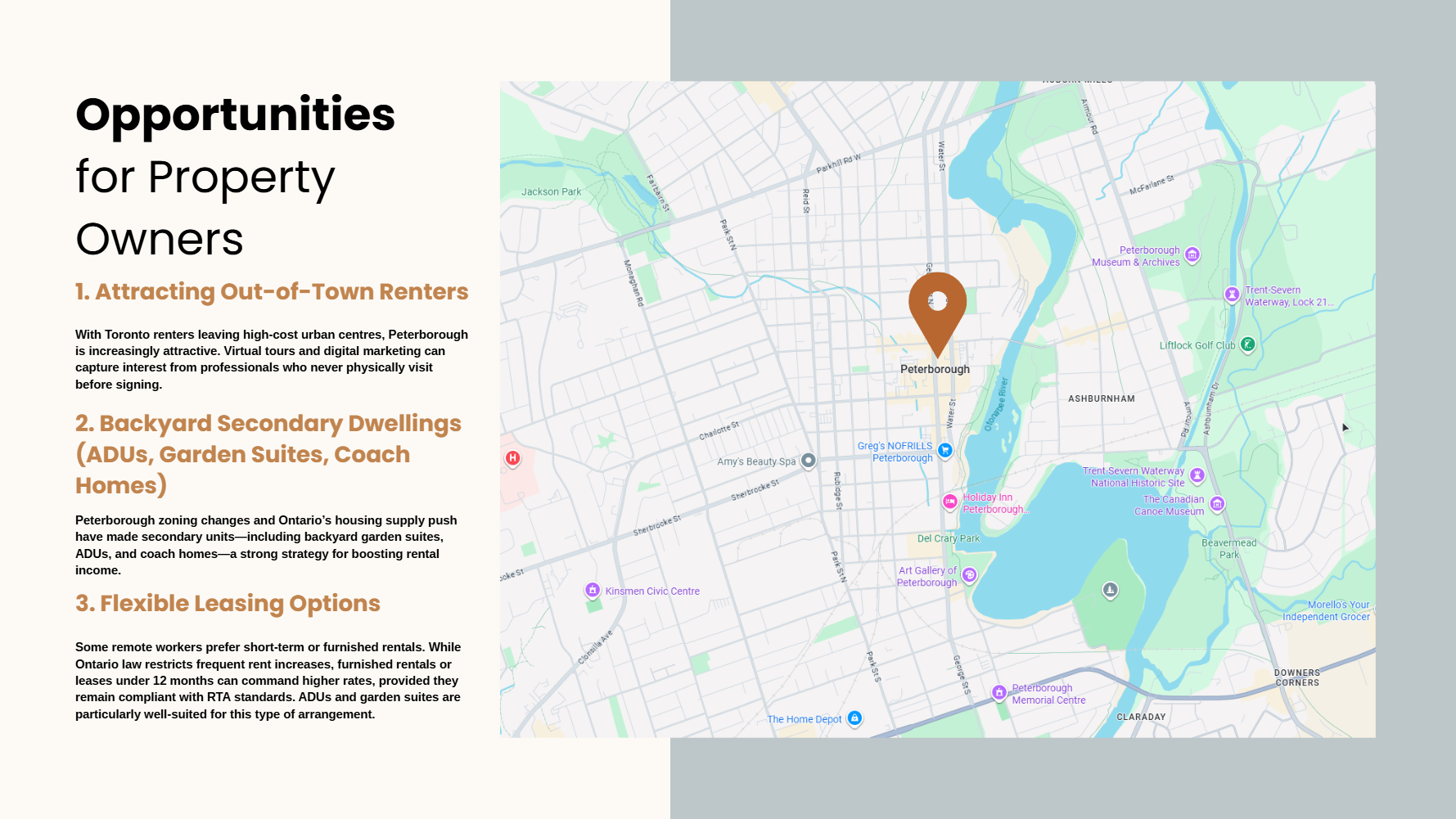
Opportunities for Property Owners - Remote Work Rentals Peterborough Real Estate - 002for Property Owners

1. Attracting Out-of-Town Renters

With Toronto renters leaving high-cost urban centres, Peterborough is increasingly attractive. Virtual tours and digital marketing can capture interest from professionals who never physically visit before signing.

2. Backyard Secondary Dwellings (ADUs, Garden Suites, Coach Homes)

Peterborough zoning changes and Ontario’s housing supply push have made secondary units—including backyard garden suites, ADUs, and coach homes—a strong strategy for boosting rental income. They offer:

  • Additional income streams from an existing property.

  • Increased property value with multi-unit potential.

  • Housing flexibility for family members or tenants.

  • Opportunities to meet rising demand for modern, private rental spaces.

Each municipality sets its own regulations on lot size, setbacks, parking, and height restrictions for ADUs, so property owners must navigate local bylaws carefully. Professional guidance ensures compliance while maximizing return.

3. Flexible Leasing Options

Some remote workers prefer short-term or furnished rentals. While Ontario law restricts frequent rent increases, furnished rentals or leases under 12 months can command higher rates, provided they remain compliant with RTA standards. ADUs and garden suites are particularly well-suited for this type of arrangement.

Challenges Owners Face

  • Increased Wear and Tear: Tenants working from home put more strain on plumbing, electrical systems, and appliances.

  • Competition: More landlords are upgrading units to attract premium tenants, making it harder for outdated rentals to compete.

  • Energy Costs: With tenants home all day, utility consumption rises, pushing owners toward energy-efficient upgrades to remain profitable.

  • Regulatory Complexity: Ontario’s landlord-tenant laws are detailed, and missteps (e.g., improper notice for entry or rent increases) can lead to costly disputes at the Landlord and Tenant Board (LTB).

How Visture Protects and Grows Rental Investments

Visture Property Group specializes in turnkey, no-hassle property management in Peterborough. We help owners stay competitive while staying compliant with Ontario law:

  1. Proactive Maintenance & Inspections
    Prevent costly repairs by addressing issues early and ensuring compliance with health and safety standards.

  2. Tenant Screening & Placement
    Rigorous checks help secure reliable tenants, reducing turnover and LTB disputes.

  3. Rent Collection & Financial Reporting
    Automated systems ensure steady cash flow and transparent reporting.

  4. Regulatory Compliance
    Full adherence to the Residential Tenancies Act, rent increase guidelines, and standard lease requirements.

  5. Coach Home & Garden Suite Development
    Expert guidance and project management for building or converting backyard spaces into legal, income-generating ADUs. From permits to construction, Visture ensures these projects maximize value while staying fully compliant with local bylaws.

What Visture wants you to remember:

Remote work has permanently changed tenant expectations in Peterborough. Demand for space, reliable internet, and comfortable living environments is rising. At the same time, Ontario’s rental rules and restrictions make self-managing more complicated than ever.

Backyard secondary dwellings—whether you call them garden suites, ADUs, or coach homes present one of the best opportunities for property owners to maximize returns and meet tenant demand. With professional management, they become an effortless, long-term revenue stream.

By partnering with Visture, property owners can adapt quickly, attract quality tenants, and grow wealth, all while avoiding the stress of navigating Ontario’s complex landlord-tenant framework alone.

Learn more about Visture’s property management and coach home solutions at visture.ca
https://www.visture.ca/wp-content/uploads/2025/10/msedge_R9pHH8NL3M.jpg 1031 1506 Dominic https://www.visture.ca/wp-content/uploads/2021/09/logo-web.png Dominic2025-10-01 06:51:412025-10-01 06:51:41How Remote Work is Transforming Property Management in Peterborough

How to Evict a Tenant in Ontario: A Guide for Property Owners

18 September, 2025

Eviction in Ontario: What Every Landlord Needs to Know

Owning rental property in Ontario comes with many responsibilities, and one of the most difficult tasks you may face as a landlord is evicting a tenant. Evictions are governed by the Residential Tenancies Act, 2006 (RTA) and overseen by the Landlord and Tenant Board (LTB). The process is not fast, and mistakes can set you back months.

At Visture, we’ve helped countless property owners manage difficult tenancies. This guide outlines how to legally evict a tenant in Ontario, what forms you must use, how long the process takes, and what pitfalls to avoid.

When You Can Legally Evict a Tenant in Ontario

You cannot remove a tenant in Ontario just because you want to. The RTA only allows eviction for specific, legally recognized reasons. The most common include:

  • Non-payment of rent
    • The tenant owes rent and hasn’t paid within the deadlines.
  • Persistent late payment
    • Even if arrears are cleared, chronic lateness is grounds.
  • Serious damage to the rental unit or building
    • Beyond normal wear and tear.
  • Illegal activity
    • For example, running an unlicensed business or illegal drug activity.
  • Interference with reasonable enjoyment
    • Repeated disturbances to neighbours or the landlord.
  • Landlord’s own use
    • You, an immediate family member, or a caregiver need the unit.
  • Demolition, conversion, or major repairs
    • If the property is being torn down, converted to non-residential use, or substantially renovated.

Important: You cannot evict a tenant because you dislike them, because they filed a complaint, or for discriminatory reasons. Every eviction must follow the letter of the law.

Step 1: Serving the Correct Notice

The eviction process starts with a formal notice to terminate tenancy. Each reason has a specific notice form and rules.

  • Form N4: Non-payment of rent.
  • Form N5: Disturbances, damage, or overcrowding.
  • Form N6: Illegal acts.
  • Form N7: Serious problems such as safety risks.
  • Form N8: Persistent late payment.
  • Form N12: Landlord’s or family’s own use.
  • Form N13: Demolition, conversion, or repairs.

You must:

  1. Use the correct form.
  2. Fill it out completely and accurately.
  3. Serve it properly (hand delivery, mail, courier, or posting on the door in specific circumstances).

Example: For non-payment, Form N4 gives the tenant 14 days (for monthly tenancies) to pay or move out. If they pay everything owed within that time, the notice is cancelled.

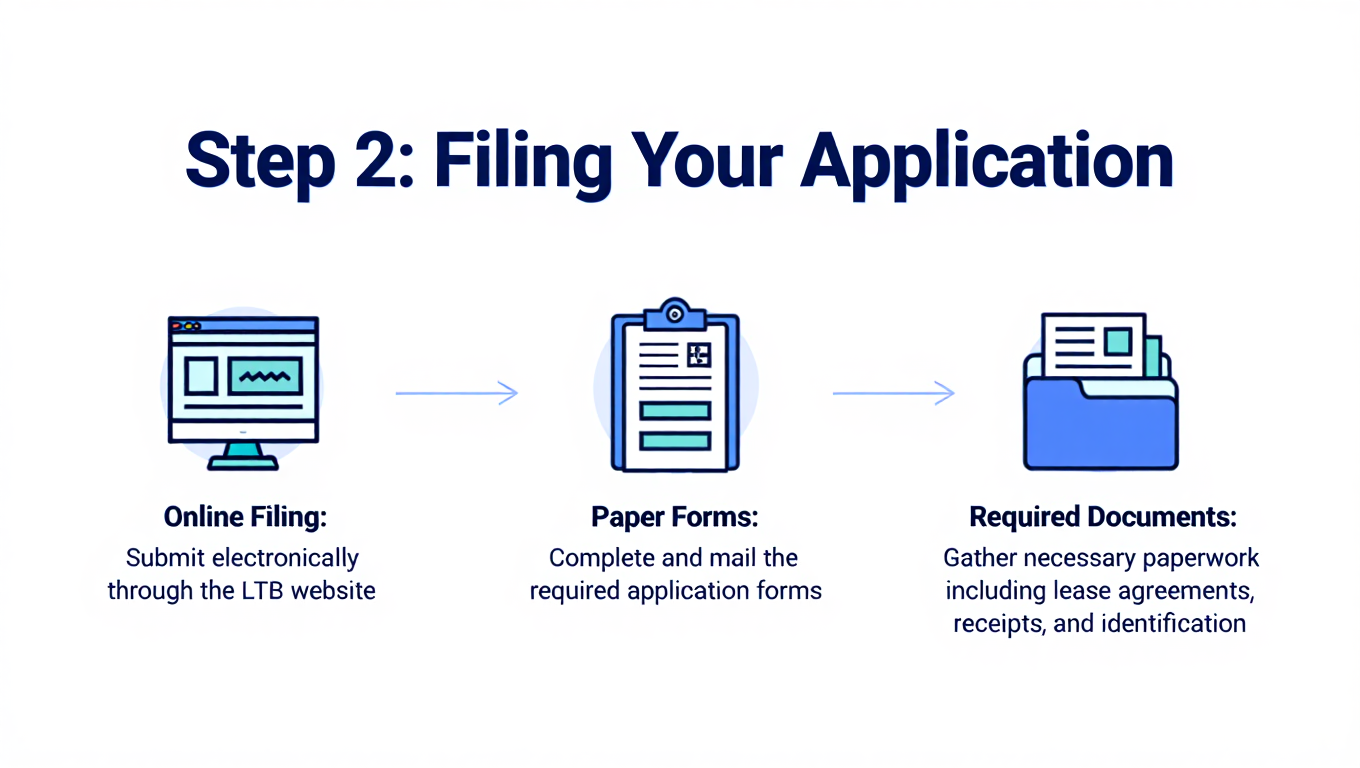
Step 2: Filing an Application with the Landlord and Tenant Board

Step 2 - Filing an Application with the Landlord and Tenant Board - How To Evict A Tenant In Ontario - 001

If the tenant does not move out or fix the problem within the notice period, you then apply to the LTB for a hearing.

  • File the appropriate application (e.g., L1 for non-payment, L2 for eviction for other reasons).
  • Pay the filing fee (currently about $201 online).
  • Submit a copy of the notice served.

The LTB will schedule a hearing, usually several weeks or months later.

Step 3: Preparing for the Hearing To Evict a Tenant in Ontario

This is where many landlords fail. You must bring evidence, not just accusations. The Board will dismiss cases if your paperwork or proof is weak.

Gather:

  • Copies of the lease.
  • Rent ledger or payment history.
  • Photographs or video of damage.
  • Written complaints from neighbours.
  • Copies of communication (texts, emails, letters).
  • Proof that the notice was served correctly.

If you’re claiming eviction for personal use, be prepared to testify and provide affidavits that you or your family genuinely intend to move in for at least one year.

Step 4: The Landlord and Tenant Board Hearing

The LTB hearing is like a small court proceeding.

  • You (or your property manager or lawyer) present your case.
  • The tenant has the right to defend themselves.
  • A Member (decision-maker) listens to both sides.

Step 4 - The Landlord and Tenant Board Hearing - How To Evict A Tenant In Ontario - 003

Possible outcomes:

  • Eviction order granted (with or without conditions).
  • Order to pay arrears with no eviction if the tenant agrees to catch up.
  • Dismissal if the Board finds your application invalid.

Hearings are often delayed due to LTB backlogs. Be prepared for the process to take several months.

Step 5: Enforcing an Eviction

Even if you win, you cannot change the locks yourself. Only the Sheriff’s Office can physically remove a tenant.

  • Once the LTB issues an eviction order, you file it with the Sheriff.
  • The Sheriff will serve the tenant with a notice to vacate.
  • If the tenant still does not leave, the Sheriff attends and removes them.

Changing locks, cutting off utilities, or removing belongings on your own is illegal and can expose you to damages.

How Long Does the Eviction Process Take?

Timelines vary, but as of 2025 most landlords experience:

  • 14 days: Tenant’s deadline on an N4 (non-payment).
  • 1–3 months: Waiting period for an LTB hearing.
  • 2–6 weeks: Sheriff enforcement after the eviction order.

Overall, expect 3–6 months from serving notice to regaining possession. Complex cases or appeals can take longer.

Common Mistakes Landlords Make

  • Wrong form used → automatically dismissed.
  • Improper service → notice not valid.
  • Not keeping records → no evidence to prove your case.
  • Self-help evictions → illegal and costly.
  • Assuming verbal agreements matter → the Board relies on written evidence.

Special Rules for “Own Use” and Renovations

If you evict a tenant because you or a family member will move in (N12) or for repairs/demolition (N13):

  • You must give at least 60 days’ notice.
  • You may have to pay one month’s rent compensation.
  • If you claim personal use but do not actually move in, the tenant can sue for bad-faith eviction.

Bad-faith evictions are taken seriously and can result in significant financial penalties.

Tenant Rights During the Process

Ontario law gives tenants several protections:

  • They can pay arrears before the LTB hearing to stop an eviction.
  • They can dispute your claims at the hearing.
  • They must be given proper notice periods.
  • They cannot be forced out without an LTB order.

As a landlord, respecting these rights protects you from legal problems and keeps your reputation intact.

Why Professional Management Helps

The eviction process in Ontario is time-consuming, procedural, and unforgiving of errors. At Visture, we often step in after a landlord has lost months due to mistakes.

Professional property management helps because:

  • We know which forms apply and how to serve them.
  • We maintain meticulous rent ledgers and records.
  • We represent you at the LTB with evidence prepared.
  • We handle communication with tenants in compliance with the RTA.

In many cases, tenants pay or move voluntarily when they see that a management company is involved and procedures are being followed properly.

Key Takeaways

  • Evictions in Ontario are controlled by the Residential Tenancies Act.
  • You must have legal grounds and use the correct forms.
  • Only the LTB can issue an eviction order, and only the Sheriff can enforce it.
  • Expect the process to take several months.
  • Mistakes in forms, service, or evidence can cost you time and money.
  • Consider professional management to reduce risk and stress.

Final Word from Visture

Being a property owner in Ontario means operating under strict rules. Evictions are not simple, but they are manageable with the right approach. If you’re facing a difficult tenancy, don’t risk doing it alone. At Visture, we combine legal knowledge with practical property management to protect your investment and restore peace of mind.

https://www.visture.ca/wp-content/uploads/2025/09/msedge_8RlHdVDSlt.jpg 1077 1614 Dominic https://www.visture.ca/wp-content/uploads/2021/09/logo-web.png Dominic2025-09-18 08:43:442025-09-18 08:44:42How to Evict a Tenant in Ontario: A Guide for Property Owners

Non-Resident Tax for Owners of Canadian Rental Property

14 September, 2025

What You Need to Know About Non-Resident Taxes For Owners of Rental Properties in Canada

Owning rental property in Ontario but living outside Canada comes with unique tax rules. Canada’s Income Tax Act imposes strict reporting and withholding obligations on non-resident owners. You need to understand your duties, deadlines, and options to avoid penalties and protect your returns.

Who Counts as a “Non-Resident”?

Non-resident status is not just about where you live today. The Canada Revenue Agency (CRA) looks at:

  • Primary ties: where your home, spouse, or dependents are located. 
  • Secondary ties: such as health card, driver’s licence, and bank accounts. 

If you don’t maintain significant ties in Canada—or if you reside here for fewer than 183 days a year—you are generally considered a non-resident for tax purposes.

Rule #1: 25% Withholding on Gross Rental Income (Part XIII Tax)

By default, whoever pays your rent—either your tenant or a Canadian agent (like a property manager)—must withhold 25% of your gross rental income each month and send it to CRA by the 15th day of the following month.

That remittance counts as CRA’s collection of your tax. In this case, you typically do not need to file a Canadian income tax return.

Each year, you will also receive an NR4 slip that shows the rental income received and the tax withheld. Your agent must file the NR4 information return with CRA by March 31.

Failing to remit on time leads to daily compound interest charges and penalties. Both you and the payer (tenant or agent) are jointly liable for the amounts owing.

Rule #2: Elect Section 216 to File a Return & Claim Expenses

You can choose to be taxed on your net rental income instead of gross. This option allows you to deduct expenses such as:

  • Repairs and maintenance 
  • Mortgage interest 
  • Property taxes 
  • Insurance 
  • Management fees 

To use this option:

  1. File Form NR6 before January 1 of the rental year, or before the first rent payment is due. 
  2. Include an estimate of your expected net rental income. 
  3. Once CRA approves the NR6, your agent can withhold 25% of the net income instead of gross. 
  4. At year-end, you must file a Section 216 tax return (Form T1159) by June 30 of the following year. 

​​A home in the background, a canadian flag on the house - What you need to know about non resident taxes for rental property owners - 002

This approach often reduces the tax payable. If too much was withheld, CRA will refund the difference after processing your return.

Warning: If you miss the June 30 deadline, your NR6 election is void. CRA will assess tax on your gross rent, even if you were withholding based on net.

Deadlines at a Glance

Form / Action Deadline
Monthly withholding remit 15th of the month following rent payment
NR4 slip & return filing March 31 of the following year
NR6 filing Before Jan 1 of the year or first payment
Section 216 return filing June 30 of the following year

Penalties and Risks

  • 10% penalty plus interest applies if withholding is late. 
  • Missing the Section 216 return deadline cancels your NR6 election, and you will be taxed on gross rental income with no deductions. 
  • Both you and your agent or tenant may be held liable for missed or incorrect remittances. 

Why Using a Canadian Agent Matters

When filing an NR6, you must name a Canadian agent. That agent is responsible for:

  • Withholding and remitting taxes correctly. 
  • Filing NR4 slips and the annual information return. 
  • Managing Section 216 returns and deadlines.

A home in the background, a window has text on it - What you need to know about non resident taxes for rental property owners - 003

At Visture, we regularly act as this Canadian agent. We ensure compliance, protect your cash flow, and handle the administration so you can focus on your investment.

Key Takeaways

  • Non-resident landlords must pay 25% tax on gross rent unless they file an NR6. 
  • Filing an NR6 allows tax to be withheld on net income instead. 
  • Section 216 returns must be filed by June 30 to claim expenses and confirm your election. 
  • Penalties and interest are strict for missed deadlines or late remittances. 
  • A trusted Canadian agent makes compliance easier and avoids costly mistakes. 

Final Word from Visture

Non-resident rental ownership in Ontario is rewarding but complex. Taxes are non-negotiable, and CRA does not show leniency for missed filings. By understanding the rules—and working with experienced professionals—you protect your investment, reduce risk, and keep more of your rental income.

https://www.visture.ca/wp-content/uploads/2025/09/​​A-home-in-the-background-a-canadian-flag-on-the-house-What-you-need-to-know-about-non-resident-taxes-for-rental-property-owners-001.png 832 1248 Dominic https://www.visture.ca/wp-content/uploads/2021/09/logo-web.png Dominic2025-09-14 12:21:132025-09-14 12:23:23Non-Resident Tax for Owners of Canadian Rental Property

Rent Increase Essentials: What Every Ontario Property Owner Needs to Know

10 September, 2025

Raising rent is one of the most sensitive responsibilities of being a landlord. Do it wrong and you risk tenant disputes, delays, or even legal penalties. Do it right and you protect your income while staying fully compliant with Ontario’s Residential Tenancies Act (RTA).

This guide explains the rules, notice periods, exemptions, and strategies for raising rent in Ontario—so you stay in control of your property without stepping outside the law.

Rent-Increase-Guidelines---What-Every-Ontario-Property-Owner-Needs-to-Know

  1. Who Sets the Rent Increase Guideline?

The Ontario government sets an annual rent increase guideline.

For 2025, the guideline is 2.5%. That means landlords can raise rent by no more than 2.5% on most residential units, unless they apply for special approval.

The guideline applies to units that were first occupied on or before November 15, 2018.

Units first occupied after November 15, 2018—such as new builds, basement apartments, or additions—are exempt from rent control. For those units, landlords can raise rent by any amount once every 12 months, provided proper notice is given.

  1. How Often Can You Raise Rent?

Rent can only be increased once every 12 months.

The 12-month period is measured either from the start of the tenancy or from the last legal rent increase.

Even if your unit is exempt from rent control, you must still respect the 12-month rule.

3. Serving Proper Notice

Ontario law requires at least 90 days’ written notice before a rent increase can take effect.

Use the official Form N1: Notice of Rent Increase.

The notice must include:

Current rent amount

New rent amount

Percentage increase

Date the increase takes effect

Statement of whether the increase is within the guideline or above it

If the notice is incomplete or served incorrectly, the rent increase is invalid, even if the percentage is correct.

  1. Above-Guideline Increases (AGI)

In certain circumstances, landlords may apply to the Landlord and Tenant Board (LTB) to raise rent by more than the guideline. This is called an Above-Guideline Increase (AGI).

When AGI Can Apply

Capital expenditures: Significant repairs or upgrades that extend the life of the property (e.g., new roof, heating system replacement).

Extraordinary increases in municipal taxes or utilities: Increases that are well above normal inflation.

Security services: New or more expensive security measures such as 24-hour guards.

Limits

The LTB generally caps AGIs at 3% above the guideline per year, for up to three years.

For extraordinary municipal tax increases, there is no cap.

Process

Give tenants 90-day notice of the proposed increase.

File an AGI application with the LTB.

Attend a hearing (phone, video, or written process).

The LTB decides whether to approve, reduce, or deny the request.

5. How to Calculate Rent Increases

Example 1: Within the Guideline

Current rent: $1,500

Guideline: 2.5%

Increase: $37.50

New rent: $1,537.50

Example 2: Above Guideline with Approval

Current rent: $1,500

Guideline: 2.5%

Approved AGI: 3% additional

Total increase: 5.5% = $82.50

New rent: $1,582.50

6. Exempt Units

If your property qualifies as exempt (occupied for the first time after November 15, 2018):

You may set any rent amount at the beginning of the tenancy.

You may increase rent by any amount, but only once every 12 months.

You must still give 90-day written notice using Form N1 or equivalent.

7. Common Mistakes Landlords Make

Raising rent too soon: Forgetting about the 12-month rule.

Improper notice: Using the wrong form or not providing all details.

Failing to document exemption: If the unit is exempt, keep building permits, occupancy certificates, or other proof.

Attempting an AGI without evidence: You need receipts, invoices, and records for capital expenditures or tax increases.

8. Tenant Rights to Challenge Increases

Tenants can dispute rent increases at the LTB if:

The notice was invalid.

The increase was above guideline without proper approval.

The landlord claimed AGI but cannot prove the expenses.

If a tenant challenges the increase, the landlord must show evidence that the increase was valid under the RTA.

  1. Strategies for Property Owners

Plan increases annually: Even if you don’t need the extra rent today, small increases each year are easier for tenants to absorb and protect your income long-term.

Document everything: Notices, receipts, and proof of exemption should always be on file.

Budget for capital expenses: If you anticipate large repairs, plan ahead so you can justify AGIs properly.

Stay professional: Rent increases are sensitive. A clear explanation and professional communication reduce disputes.

10. Quick Reference Table

Rule Requirement
Frequency Maximum once every 12 months
Notice 90 days’ written notice (Form N1)
Guideline for 2025 2.5%
Exempt Units Occupied after Nov 15, 2018 – not subject to cap
Above Guideline Increase Requires LTB approval; up to 3% above guideline/year
Documentation Lease, notices, receipts, tax records, AGI evidence

Final Word from Visture

Raising rent in Ontario isn’t complicated, but it is structured. Stick to the guideline, respect the 12-month and 90-day rules, and keep your paperwork tight. If you need an AGI, be prepared with strong evidence.

At Visture, we help property owners apply the rules correctly. From drafting notices to representing landlords at the LTB, we manage the process so you don’t risk delays or disputes.


https://www.visture.ca/wp-content/uploads/2025/09/Rent-Increase-Guidelines-What-Every-Ontario-Property-Owner-Needs-to-Know-002-scaled.jpg 1708 2560 Dominic https://www.visture.ca/wp-content/uploads/2021/09/logo-web.png Dominic2025-09-10 17:58:532025-09-10 17:58:53Rent Increase Essentials: What Every Ontario Property Owner Needs to Know

Investing in Canadian Real Estate as a Foreigner

1 September, 2025

Investing in Canadian Real Estate as a Foreigner: What Property Owners Should Know

Canada’s real estate market attracts global attention, but foreign investors face unique restrictions, taxes, and compliance rules. If you’re considering purchasing property in Canada as a non-resident, you need to understand what is possible, what is prohibited, and how to structure your investment to stay compliant.

1. Federal Ban on Residential Purchases

  • Since January 1, 2023, a federal law prohibits non-Canadians from buying most residential property in Canada.

  • This ban has been extended until January 1, 2027.

  • “Residential property” means buildings with up to three dwelling units, including detached houses, semi-detached houses, row houses, condominium units, and similar structures.

  • The ban mainly affects urban areas (census metropolitan and agglomeration zones). Properties in smaller rural or recreational areas are generally not restricted.

  • Exceptions exist:

    • Large buildings with four or more units are not covered.

    • Some categories of foreign nationals (such as work permit holders meeting certain conditions) may be exempt.

    • Commercial property and land zoned for development are not restricted.

2. Provincial and Municipal Taxes

Even if the federal ban does not apply, foreign buyers must account for significant additional taxes:

  • Ontario Non-Resident Speculation Tax (NRST): 25% of the purchase price of certain residential properties in Ontario.

  • Toronto Municipal Non-Resident Speculation Tax (MNRST): An additional 10% applies within the City of Toronto.

  • These taxes apply on top of regular land transfer taxes, legal fees, and closing costs.

3. Commercial and Rural Properties

The ban targets residential housing, not all real estate. Foreign investors can still:

  • Purchase commercial properties such as retail, office, or industrial buildings.

  • Buy land for development or farmland, depending on provincial restrictions.

  • Acquire multi-unit residential buildings with four or more units, which are excluded from the ban.

Commercial and Rural Properties - Buy Rural Properties in Canada - 001

These opportunities remain open, though taxes and financing conditions still apply.

4. Ownership Structures for Foreign Investors

Foreign investors often use structured ownership arrangements to meet Canadian requirements:

  • Corporations: Setting up a Canadian subsidiary or registering extra-provincially.

  • Partnerships: Joint ventures with Canadian investors, limited partnerships, or LLPs.

  • Trusts: Bare trusts or discretionary trusts where a Canadian trustee holds legal title.

Each option carries different liability, tax, and reporting obligations. Legal advice is strongly recommended before choosing a structure.

5. Investment Canada Act (ICA)

Significant foreign investments in Canadian businesses—including real estate businesses—may be subject to review under the Investment Canada Act. The federal government can assess whether an investment provides a net benefit to Canada or raises national security concerns. While this rarely applies to individual property purchases, it can apply to large-scale acquisitions by foreign corporations.

6. Taxation of Non-Resident Owners

Even when ownership is allowed, foreign investors face tax obligations:

  • Rental income is taxable in Canada. Non-residents must remit withholding tax on gross rent unless they elect to be taxed on net income (Section 216 filing).

  • Capital gains tax applies when the property is sold. Non-residents must obtain clearance certificates from the Canada Revenue Agency (CRA), and part of the sale proceeds may be withheld at closing.

  • Annual compliance includes filing the proper Canadian tax returns, remitting tax on time, and meeting CRA deadlines.

Failure to follow tax rules can result in penalties, interest charges, and problems completing a sale.

7. Market Impact and Context

Foreign ownership has historically represented a small percentage of Canadian real estate. However, in major cities like Toronto and Vancouver, it has drawn attention due to perceptions of price impact. This contributed to both the federal ownership ban and additional provincial/municipal taxes targeting foreign buyers.

For investors, this means navigating not just market fundamentals but also political and regulatory environments.

Alternatives To Direct Ownership For Foreigners Investing in Real Estate in Canada - 001

8. Alternatives to Direct Ownership

If buying residential property directly is not possible due to the ban or taxes, foreign investors can still access Canadian real estate returns through indirect approaches:

  • Mortgage Investment Corporations (MICs): Pooled funds that invest in mortgages, paying investors a share of the income.

  • Real Estate Investment Trusts (REITs): Publicly traded or private trusts that own income-producing properties across Canada.

  • Partnership with Canadian investors: Joint ventures where the Canadian party takes legal title while the foreign partner contributes capital.

These routes avoid ownership restrictions while providing exposure to the Canadian property market.

9. Quick Reference Table

Category Key Rules and Takeaways
Federal Residential Ban In place until January 1, 2027; applies to residential properties with up to 3 units in urban areas
Exempt Properties Multi-unit (4+), commercial, and rural or development-zoned land
Ontario NRST 25% additional tax on certain residential purchases by non-residents
Toronto MNRST 10% additional municipal tax on foreign buyers
Ownership Structures Options include corporations, partnerships, and trusts
Tax Obligations Rental income, capital gains, and annual CRA compliance required
ICA Review Applies to large or sensitive business investments
Alternatives MICs, REITs, or joint ventures with Canadian owners

Final Word from Visture

Foreign investment in Canadian real estate is no longer straightforward. Federal restrictions, provincial and municipal taxes, and ongoing compliance requirements mean you must be informed before acting.

If you’re considering an investment:

  • Confirm whether the property type is restricted or exempt.

  • Calculate additional taxes and closing costs.

  • Decide on the most effective ownership structure.

  • Plan for ongoing tax compliance as a non-resident.

  • Explore indirect investment options if direct ownership isn’t possible.

At Visture, we guide property investors through every stage—compliance, structuring, management, and tax planning—so you can invest confidently and within the law.

https://www.visture.ca/wp-content/uploads/2025/09/msedge_egDfM0XDDV.png 289 443 Dominic https://www.visture.ca/wp-content/uploads/2021/09/logo-web.png Dominic2025-09-01 18:13:342025-09-01 18:13:34Investing in Canadian Real Estate as a Foreigner

Seasonal Maintenance for Rental Properties

2 July, 2025

Keep Your Investment Running Smoothly Year-Round with our actionnable seasonal maintenance guide for rental properties

If you own or manage rental properties, seasonal maintenance isn’t optional—it’s how you protect your investment and avoid chaos down the road. Ignoring routine upkeep is how small issues quietly turn into major repair bills. Worse, it’s how you lose good tenants.

Staying ahead of the seasons helps you avoid last-minute scrambles, keeps your property safe and functional, and gives your tenants one less thing to complain about. Here’s how to break down your maintenance by season so nothing slips through the cracks.


Spring: Fix Winter Damage and Prepare for Summer

Spring is when you find out what winter broke. Start by walking the property. Look for anything cracked, leaking, sagging, or growing mold.

  • Roofs and gutters take a beating in cold climates. You’ll want to check for missing shingles and clean out leaves or ice residue.
  • Exterior walls and foundations can crack or shift. Look for moisture damage, water stains, and gaps around windows.
  • Now’s the time to refresh landscaping. Trim back overgrowth, reseed patchy lawn spots, and clear debris.

Inside, give your HVAC some attention. Schedule a spring tune-up for the A/C system and swap out filters. While you’re at it, test smoke and carbon monoxide detectors, and look under sinks for any signs of slow leaks. Spring is also when bugs start moving again—take pest control seriously now before it becomes a bigger issue.


Summer: Keep Cool and Stay Ahead of the Wear and Tear

Summer brings tenant complaints about heat, insects, and anything that rattles, hums, or leaks. Use this time to tighten up systems and reinforce your curb appeal.

Your A/C should be humming efficiently. If tenants are constantly fiddling with the thermostat, there could be a ventilation issue. Encourage monthly filter changes and double-check insulation in top-floor units.

Outside, make sure irrigation systems aren’t leaking or spraying the building. Wooden decks may need resealing, especially if they see heavy use. And don’t forget driveways—hot weather can make small cracks worse fast.

Summer is also a good time to communicate with tenants. Send a short list of energy-saving tips, remind them how to report maintenance issues, and make sure they understand any policies around grills, outdoor furniture, or guest parking.


Fall: Get the Property Ready for Colder Months

Autumn is about getting ahead of the cold. If you’re reacting to freezing temps, you’re already behind.

Start with the gutters. You cleaned them in spring, but now they’re full of leaves again. If they overflow, you’ll deal with ice dams or flooded basements. Seal up gaps around windows and doors, and re-caulk where needed.

Schedule a furnace inspection before temperatures drop. Replace filters and confirm heat is working in all units. If your property has fireplaces or wood stoves, make sure the chimneys are cleaned and inspected.

Don’t forget the outdoor plumbing. Shut off outdoor faucets, drain hoses, and winterize sprinkler systems. A burst pipe is one of the fastest ways to blow your maintenance budget.


Winter: Keep It Safe and Warm

Winter is mostly about preventing problems you can’t see—frozen pipes, slow leaks, drafts, and hidden moisture.

Make sure your snow removal plans are in place. Tenants slipping on unshoveled sidewalks is a liability you don’t want. Keep salt or ice melt available near entrances and walkways.

Inside, inspect for signs of condensation, especially near windows and in basements. Encourage tenants to ventilate bathrooms and use dehumidifiers if needed. Drafts can usually be fixed with new weather stripping or door sweeps.

Pipes are your biggest risk. Remind tenants to keep the heat on, even when away, and to open cabinet doors during extreme cold spells to let warm air circulate.


What You Should Be Doing All Year

Not everything fits neatly into one season. Some tasks should be on your radar year-round.

  • Schedule quarterly walkthroughs of common areas and exteriors.
  • Keep a log of maintenance work and communication with tenants.
  • Stay connected to a network of reliable contractors for plumbing, HVAC, electrical, and emergency repairs.

The Payoff

A clean, functional, well-maintained rental doesn’t just look good—it rents faster, retains good tenants, and costs less over time. Regular seasonal maintenance protects your revenue and reputation, and it gives tenants less reason to call you at 10 PM on a Sunday.

It’s property management 101: maintain consistently, not reactively. Stay ahead of the seasons and your rental will run smoother year-round.

https://www.visture.ca/wp-content/uploads/2025/07/Seasonal-Maintenance-for-Rental-Properties-2.png 832 1248 Dominic https://www.visture.ca/wp-content/uploads/2021/09/logo-web.png Dominic2025-07-02 22:22:212025-07-02 22:24:46Seasonal Maintenance for Rental Properties

Marketing Your Renovated Property: Tips and Strategies to Attract Tenants Fast

23 June, 2025

Learn how to attract tenants with marketing tips on your newly renovated rental property

When your rental property has just undergone a renovation, time is of the essence. Every vacant day eats into your ROI. Strategic marketing helps attract the right tenants quickly—while maximizing the return on your renovation spend. Here’s how to do it right.


1. Treat Your Property Like a Product Launch

A newly renovated unit deserves more than a rushed Kijiji post or a couple of blurry phone photos. Think of it like launching a product:

  • Build anticipation: Tease the property on your company’s social media before it’s listed.
  • Create a “Coming Soon” listing: Use this to build a waitlist of interested tenants before final cleanup is done.

2. Invest in Professional Photography and Videography For Rental Properties

Images are the first (and often only) impression you’ll get.

  • Use wide-angle lenses to show space clearly.
  • Shoot at the right time of day—natural light sells.
  • Include photos of upgrades: Show the new flooring, appliances, lighting fixtures, or tilework.
  • Create a virtual tour or walkthrough video: Helps reduce in-person no-shows and appeals to out-of-town renters.

Tip: Add call-outs in your photos or video—“Brand-new stainless appliances,” “Quartz countertops,” etc.


3. Write Rental Listings That Sell

Most listings bury the lead or describe upgrades generically. Instead:

  • Start with what’s new: e.g., “Fully renovated 2BR with new kitchen, bathroom, and flooring.”
  • Use bullet points for clarity. Example:
    – Brand new kitchen with quartz countertops and soft-close cabinetry  
    – Full bathroom remodel with rain shower and built-in shelving  
    – Energy-efficient windows and new in-unit washer/dryer  
    
  • Include keywords tenants search for: “pet-friendly,” “parking included,” “in-unit laundry,” “close to transit,” etc.

4. Choose the Right Platforms To Promote Your Rental Property

Don’t just stick with Facebook Marketplace and Craigslist. Depending on your region, expand to:

Platform Best For
Zillow/Rentals.ca Serious renters looking for long-term leases
Facebook Marketplace Wide reach, but higher noise
Kijiji/Craigslist Local searchers—include lots of images
PadMapper/TorontoRentals Urban centres with high tenant turnover
TikTok or Instagram Reels Showcase before-and-afters in short video format

Tip: Tag location-based hashtags on Instagram: #TorontoRentals #PeterboroughLiving


5. Targeted Rental Property Paid Ads

Use geo-targeted Facebook and Google Ads to promote the listing. Narrow down by:

  • Location (within 10–25 km of the address)
  • Demographics (age, renter profile, income level if appropriate)
  • Interests (moving, apartments, student housing, etc.)

Keep ads short and visual-heavy. Example headline:

“Fully Renovated 2BR in Downtown—Brand New Kitchen, Parking Included. Available Now.”


6. Leverage Renovation Before/After Content

People love transformation stories. Use your reno photos to create content like:

  • Instagram carousel: “Swipe to see the transformation”
  • Blog post: “How we modernized this 70s unit for today’s renters”
  • Facebook post: “This space went from outdated to move-in ready. What do you think?”

This not only builds trust but creates social proof that you maintain your properties.


7. Reputation and Reviews Matter

Even a great unit will struggle if your company has poor online reviews.

  • Ask happy tenants to leave Google reviews
  • Respond to all reviews, especially critical ones, showing you care and take feedback seriously

Feature positive reviews in your listings or social posts.


8. Offer Incentives That Make Sense

Early lease-up bonuses can move your unit faster. Examples:

  • 1 month free on a 13-month lease
  • $100 gift card for approved tenants who apply within 48 hours
  • Free parking for the first 3 months

Just avoid slashing rent unless necessary. Lead with value, not desperation.


9. Use Strategic Signage and Local Outreach

If the property is on a walkable street:

  • Add a “Now Leasing” sign with a text-for-info number or QR code
  • Flyers in local cafés or grocery stores can still work in the right neighborhoods

10. Partner with Local Employers or Schools

If you’re near a university, hospital, or business park:

  • Offer exclusive access or discounts to employees or students
  • Get on employee housing boards or classified lists

Marketing rental properties after a renovation is more than just showing it’s clean and new. You need to position the space, communicate the upgrades, and make it easy for tenants to imagine themselves living there. With the right strategy, your renovated unit won’t sit empty for long.

https://www.visture.ca/wp-content/uploads/2025/06/A-bright-newly-renovated-condo-unit-with-large-kitchen-island-Marketing-Your-Renovated-Property-Tips-and-Strategies-to-Attract-Tenants-Fast.webp 768 1360 Dominic https://www.visture.ca/wp-content/uploads/2021/09/logo-web.png Dominic2025-06-23 14:21:062025-06-23 14:21:06Marketing Your Renovated Property: Tips and Strategies to Attract Tenants Fast

DIY vs. Hiring Professionals: Making the Right Choice

13 June, 2025

When deciding between DIY renovations and hiring professionals, weigh your skills, time, and the project’s complexity. DIY work can save money and build creativity, but it might lead to costly mistakes or safety risks.

On the other hand, professionals guarantee high-quality results and efficient project management. Consider your budget and how much value the project will add to your home. There’s a balance to strike, and you might find useful insights to help you choose.

Key Questions to Assess Your Renovation Approach

Recognizing when to hire professionals versus tackling a project yourself is just the starting point.

To make the right decision, ask yourself key questions to clarify your project priorities and perform a skill assessment.

Consider the following:

  • What’re my specific project goals, and how can I achieve them most effectively?
  • Do I have the necessary skills and tools to complete this project without compromising quality?
  • How much time can I realistically dedicate to this renovation without disrupting my daily life?
  • Will this project add significant value to my home, justifying the investment of time and resources?

Understanding the Benefits of DIY Renovations

While some homeowners might hesitate to plunge into DIY renovations, embracing this hands-on approach can lead to significant benefits.

You’ll discover your DIY creativity as you design and execute projects that reflect your style. Not only can you save money through cost efficiency by avoiding labor fees, but you’ll also gain valuable skill development that prepares you for future tasks.

Tackling various projects enhances your capabilities, making each renovation easier than the last. Additionally, the personal satisfaction you’ll feel when completing a project is unmatched; seeing your hard work come to life in your home can be incredibly rewarding.

The Advantages of Hiring Professionals

Although DIY renovations can be rewarding, hiring professionals offers distinct advantages that might suit your needs better. When you bring in experts, you gain access to superior skills and knowledge that can transform your project. Their expert craftsmanship guarantees high-quality results, while effective project management keeps everything on track and within budget.

  • Efficiency: Professionals can complete tasks faster, minimizing disruption in your home.
  • Safety: Experts follow codes and regulations, reducing risks associated with DIY errors.
  • Stress Reduction: Letting professionals handle the details frees you from the complexities of planning and execution.
  • Long-Term Value: Investing in skilled labor often leads to higher-quality results that stand the test of time.

Evaluating When DIY Is Not Worth It

When tackling renovations, it’s essential to recognize situations where DIY efforts mightn’t be worth the hassle.

If your project involves significant structural integrity concerns, like foundation issues or load-bearing walls, it’s wise to call in professionals. These renovation challenges often require expertise and specialized tools that you mightn’t possess.

If you’re facing outdated layouts that demand complex alterations, the risk of costly mistakes rises dramatically. Remember, DIY projects can quickly spiral out of control, leading to safety hazards and financial strain.

It’s better to invest in professional help for projects that could jeopardize your home’s safety or value, ensuring peace of mind and a polished outcome.

Budgeting for Renovations: DIY vs. Professional Costs

While evaluating your renovation options, understanding the costs associated with DIY projects versus hiring professionals is crucial.

A cost comparison reveals that DIY can save you significant labor costs, but remember, your time is valuable. If you’re confident in your skills, you can maintain tight renovation budgeting. However, be cautious of potential mistakes that could lead to costly repairs down the line.

On the other hand, hiring professionals guarantees quality and efficiency, though it comes with a higher price tag. Ultimately, weigh your budget against the complexity of the project. If you’re tackling something intricate, investing in professional help might be worth it to avoid headaches and guarantee a polished result.

Choose wisely based on your financial situation and skill set.

Considering the Long-Term Value of Your Home

As you plan your renovations, it’s essential to evaluate how your choices will impact your home’s long-term value.

Investing wisely can boost property appreciation and enhance your resale potential

Consider the following factors while making decisions:

  • Quality of materials and craftsmanship can affect durability and appeal.
  • Updating key areas like kitchens and bathrooms often yields higher returns.
  • Energy-efficient upgrades attract buyers and reduce long-term costs.
  • Market trends in your area can influence what renovations are most valuable.

Finding the Right Balance Between DIY and Professional Help

How can you effectively find the right balance between DIY projects and hiring professionals?

Start by evaluating your DIY limitations. Consider your skills, available time, and the complexity of the project. If a task seems overwhelming or vital for safety, it might be time to seek professional partnerships.

Weigh the cost savings of DIY against the potential for costly mistakes. It’s important to recognize when a professional’s expertise can save you time and guarantee quality results.

Look for projects that let you express creativity while also knowing when to let go and trust a professional.

Finding this balance can lead to successful renovations that meet your goals without unnecessary stress.

https://www.visture.ca/wp-content/uploads/2025/06/msedge_M0FzHkChU2.jpg 1218 2176 Dominic https://www.visture.ca/wp-content/uploads/2021/09/logo-web.png Dominic2025-06-13 14:52:432025-06-13 14:52:43DIY vs. Hiring Professionals: Making the Right Choice

Preparing for Inspections: What Landlords Need to Know

9 June, 2025


How To Prepare For Inspections: Expectations, Checklist and everything inbetween.

Property inspections in Peterborough, Ontario are a regular part of managing rentals. Whether it’s an annual walkthrough, a tenant changeover, or a response to a city bylaw requirement, inspections are where small problems become big ones if you’re not ready.

Landlord preparation makes the difference between a smooth check and a compliance headache.

Here’s what you need to know — and do — to get your rental property inspection-ready.


1. Understand the Type of Inspection

Different inspections focus on different things. You need to know what’s being checked:

  • Routine inspections: You’re looking for damage, wear and tear, and maintenance issues.
  • City or bylaw inspections: Peterborough often checks for fire safety, occupancy limits, and property standards.
  • Insurance inspections: Inspectors verify conditions tied to your insurance policy.
  • Move-in/move-out inspections: Documentation of the property’s condition before and after a tenant’s lease.

Clarify the purpose before you prep.


2. Notify Your Tenants Properly

In Ontario, you must give 24 hours’ written notice before entering the unit for inspection.

The notice needs to include:

  • The reason for entry (e.g., inspection)
  • The date and time (within a reasonable window)

Tenants have rights. Skipping proper notice can delay the inspection or cause legal problems.


3. Focus on Key Compliance Areas

Inspectors and tenants will look at different things, but you must cover both bases for full rental property compliance:

Fire Safety

  • Check smoke and carbon monoxide alarms — replace batteries and test alarms.
  • Confirm that exits are clear and unblocked.
  • Make sure fire extinguishers are in place (especially in multi-unit properties).

Electrical Systems

  • Look for exposed wiring or broken outlets.
  • Test light switches and fixtures.
  • Confirm that breaker panels are accessible and labeled.

Plumbing

  • Check for leaks under sinks and around toilets.
  • Run all taps and flush toilets to confirm they’re working.
  • Clear any visible blockages or drainage issues.

Heating and Ventilation

  • Test the furnace and check for filter replacements.
  • Ensure vents and windows are unobstructed.
  • Confirm that all rental units have proper heating (minimum 20°C under Ontario law).

General Maintenance

  • Repair any broken windows, doors, or locks.
  • Replace burnt-out bulbs and fix loose handrails.
  • Patch and paint damaged walls if needed.

4. Address Exterior and Common Areas

Don’t focus only on the inside — outside matters too:

  • Clean gutters and inspect the roof for damage.
  • Confirm that walkways, driveways, and steps are clear and in good repair.
  • Check that outdoor lighting works for tenant safety.

City inspections often focus on the property’s curb appeal and safety.


5. Document Everything

Before the inspection:

  • Take clear, dated photos of each room.
  • Keep receipts for repairs or upgrades.
  • Have maintenance logs ready, especially for HVAC, pest control, and fire safety systems.

Good documentation protects you from false claims and shows inspectors you take rental property compliance seriously.


6. Communicate With Tenants

Let tenants know what to expect:

  • Tell them what areas will be inspected.
  • Encourage them to point out any issues.
  • Remind them to secure pets and valuables.

Happy tenants are less likely to make complaints during or after an inspection.


7. Common Red Flags Inspectors Look For

Based on common Peterborough standards and bylaws, watch out for:

Red Flag Why It’s a Problem
Missing smoke/CO alarms Fire code violation — fines and liability risk.
Peeling paint/mold Health and safety issue.
Overcrowded units Occupancy limit breach.
Broken locks/windows Security issue.
Garbage buildup/exterior mess Property standards bylaw violation.

8. Plan for Follow-Ups

If the inspection finds issues, fix them fast:

  • Prioritize health and safety problems.
  • Schedule repairs immediately and keep records.
  • Confirm with the inspector if a recheck is needed.

Delays in addressing problems can lead to fines or notices from the city.


9. Stay Consistent

Don’t wait for inspections to find problems. Set a regular inspection schedule:

  • Every six months for internal inspections.
  • Seasonal checks for exterior maintenance.
  • Annual fire safety inspections.

Staying ahead avoids surprises.

Landlord preparation is key to passing property inspections and keeping your rental business smooth. In Peterborough, with its specific rental bylaws and fire codes, a little work upfront saves you from bigger issues later. Focus on tenant communication, property maintenance, and compliance documentation, and you’ll handle inspections with minimal stress.

https://www.visture.ca/wp-content/uploads/2025/06/Preparing-For-Inspections-What-Landlords-Need-To-Know-Landlord-preparation-makes-the-difference-between-a-smooth-check-and-a-compliance-headache.jpg 1080 1920 Dominic https://www.visture.ca/wp-content/uploads/2021/09/logo-web.png Dominic2025-06-09 13:06:362025-06-09 13:07:17Preparing for Inspections: What Landlords Need to Know

Eco-Friendly Renovations for Rental Properties: How Sustainability Pays Off

15 May, 2025

Green Up, Cash In: Eco-Friendly Renovations That Pay Off

With rising energy prices and increasing environmental awareness, eco-friendly renovations are no longer a niche trend — they’re a smart investment. For property owners and managers, adopting sustainable renovation strategies helps attract environmentally conscious tenants, reduce long-term operational costs, and future-proof properties against tightening regulations.

Whether you’re managing a single unit or a multi-residential complex, making your rental properties more sustainable is a win-win — and companies like Visture are already leading the way in building smarter, greener communities.


Why Eco-Friendly Renovations Matter

Today’s tenants — especially millennials and Gen Z — are actively looking for rental properties aligned with their values. According to a 2023 RentCafe survey, 72% of renters said they would pay more for eco-friendly features that reduce their environmental footprint.

Sustainable rental properties:

  • Attract high-quality, long-term tenants
  • Lower utility bills (for landlords or tenants, depending on the setup)
  • Improve asset value and resale potential
  • Reduce maintenance through durable, low-impact materials
  • Comply with emerging green building codes and standards

High-Impact Eco-Friendly Renovation Ideas

Here are some of the most effective and practical green upgrades for rental properties:

1. Energy-Efficient Windows and Doors

  • Why: Old windows cause heat loss and higher HVAC bills.
  • Upgrade: Install double or triple-pane windows with low-emissivity (Low-E) coatings.
  • Bonus: Tenants appreciate quieter interiors and lower utility bills.

2. Smart Thermostats

  • Why: Helps regulate heating and cooling based on occupancy.
  • Popular Options: Google Nest, Ecobee.
  • Landlord Benefit: Reduces HVAC wear and energy use during vacancies.

3. Low-Flow Water Fixtures

  • Includes: Faucets, showerheads, and dual-flush toilets.
  • Savings: Reduces water bills by up to 30%.
  • Appeal: Tenants like knowing their daily habits waste less water.

4. LED Lighting

  • Why: Uses 75% less energy and lasts 25x longer than incandescent bulbs.
  • Tip: Use daylight sensors or motion detectors in shared spaces and hallways.

5. Sustainable Flooring

  • Options: Bamboo, cork, reclaimed wood, or recycled composite.
  • Why it matters: These are durable, renewable, and low in VOCs.

6. Eco-Friendly Insulation

  • Materials: Recycled denim, cellulose, or sheep’s wool.
  • Benefit: Keeps heating and cooling costs down, increases comfort.

7. Solar Panels (Where Feasible)

  • Ideal For: Detached properties or buildings with roof access.
  • Considerations: Upfront costs are high, but incentives and rebates may apply.
  • ROI: Long-term electricity cost reductions and environmental credibility.

8. Rainwater Collection or Permeable Landscaping

  • Why: Minimizes stormwater runoff and supports low-water landscaping.
  • Enhancement: Native plants or xeriscaping to reduce irrigation needs.

Don’t Forget Indoor Air Quality

Today’s tenants care about more than energy savings. Healthy indoor environments are a top priority:

  • Use low-VOC paints and sealants
  • Install HEPA air filtration systems
  • Incorporate natural ventilation or ERV (energy recovery ventilation) units

How to Market Your Eco-Friendly Rental

Once the upgrades are complete, make sure you highlight them in your listing copy and showings. Use phrases like:

  • “Green-certified upgrades”
  • “Low utility bills thanks to energy-efficient systems”
  • “Modern, eco-conscious design for sustainable living”

Include details in brochures, digital tours, and your website. If you’re working with a property management company, ask how they promote green features.


The Visture Advantage: Smarter Property Management

Visture Property Group doesn’t just manage rentals — they build sustainable living communities designed for the future. Their approach to Smart Rentals™ includes:

  • Green renovations and high-efficiency systems
  • Modern property upgrades that tenants actually care about
  • Professional management focused on comfort, sustainability, and profitability

If you’re a property owner looking to attract better tenants, reduce operating costs, and increase your ROI — partnering with a team like Visture means your investment is not just managed, but optimized.


Final Thoughts

Eco-friendly renovations for rental properties are no longer optional — they’re a strategic move. As tenants demand sustainable features and governments introduce greener building codes, now is the time to start.


https://www.visture.ca/wp-content/uploads/2025/05/​an-image-of-an-appartment-with-green-recycling-bin-and-on-the-side-of-the-fridge-bold-text-writes-Eco-Friendly-Renovations-for-Rental-Properties.png 832 1248 Dominic https://www.visture.ca/wp-content/uploads/2021/09/logo-web.png Dominic2025-05-15 21:44:592025-05-15 21:45:23Eco-Friendly Renovations for Rental Properties: How Sustainability Pays Off
Page 2 of 10‹1234›»

Get Your FREE
Property Management
Short Course

Get Course Now
Search Search

Recent Posts

  • Selling your home this spring in Peterborough or nearby? See which renovations actually raise value in Ontario’s 2026 market and which upgrades to skip.
    Selling Your Home This Spring? The Top Renovations That Actually Maximize ROI in Ontario’s 2026 Market6 March, 2026 - 10:17 am
  • Ontario Bill 60 Landlord Fair LTB Process - 001
    Good News for Landlords: Ontario Bill 60 Brings Faster, Fairer LTB Processes27 January, 2026 - 1:35 pm
  • Peterborough Facade Improvement Grant - Improve Your Home Facade and value with the PTBO Grant to update your home - 001
    Facade Improvement Grant Program: how Peterborough owners can upgrade, add value, and plan smarter6 January, 2026 - 11:00 am
  • New Ontario Fire Code - Carbon Monoxide Detector January 1st 2026 - 001
    New Ontario Fire Code Rules for Carbon Monoxide Alarms Take Effect January 1, 20264 January, 2026 - 4:47 pm
  • Learn from The EXPAND Conference JG Francoeur’s Panel (Watch Full Video Here)25 November, 2025 - 12:15 pm
  • Peterborough Real Estate Portfolio Diversification - Diversify Real Estate Folio in PTBO Ontario - 001
    Diversifying Your Real Estate Portfolio in Peterborough Ontario | 4 Proven Strategies3 November, 2025 - 7:08 am
  • Diversifying Your Real Estate Portfolio in Peterborough Ontario - Proven Strategies To Increase Revenue And Diversify Portfolio Real Estate Investments Peterborough Ontario - 001
    Diversifying Your Real Estate Portfolio in Peterborough Ontario3 October, 2025 - 9:42 am
  • How Remote Work is Transforming Property Management in Peterborough
    How Remote Work is Transforming Property Management in Peterborough1 October, 2025 - 6:51 am

Oshawa | Peterborough | Lindsay | Kawartha Area | Orillia | Barrie | Huntsville | Ontario

  • vpm@visture.ca
  • 705-998-2017
  • 552 Armour Rd. Peterborough ON Canada

Visture Awards

© 2025 Visture Property Group LLP | Privacy Policy

Scroll to top Scroll to top Scroll to top