
• 705-998-2017
  • vpm@visture.ca
Visture Property Group
  • Home
  • What We Do
    • For Property Owners
    • For Tenants
    • Virtual Staging
    • Coach Home (ADU) Construction
    • Coach Home Site Evaluation
    • Financial Services
  • Who We Are
  • FREE Resources
  • For Rent
  • Events
  • Blog
  • Contact
  • Menu Menu

How to Evict a Tenant in Ontario: A Guide for Property Owners

18 September, 2025

Eviction in Ontario: What Every Landlord Needs to Know

Owning rental property in Ontario comes with many responsibilities, and one of the most difficult tasks you may face as a landlord is evicting a tenant. Evictions are governed by the Residential Tenancies Act, 2006 (RTA) and overseen by the Landlord and Tenant Board (LTB). The process is not fast, and mistakes can set you back months.

At Visture, we’ve helped countless property owners manage difficult tenancies. This guide outlines how to legally evict a tenant in Ontario, what forms you must use, how long the process takes, and what pitfalls to avoid.

When You Can Legally Evict a Tenant in Ontario

You cannot remove a tenant in Ontario just because you want to. The RTA only allows eviction for specific, legally recognized reasons. The most common include:

  • Non-payment of rent
    • The tenant owes rent and hasn’t paid within the deadlines.
  • Persistent late payment
    • Even if arrears are cleared, chronic lateness is grounds.
  • Serious damage to the rental unit or building
    • Beyond normal wear and tear.
  • Illegal activity
    • For example, running an unlicensed business or illegal drug activity.
  • Interference with reasonable enjoyment
    • Repeated disturbances to neighbours or the landlord.
  • Landlord’s own use
    • You, an immediate family member, or a caregiver need the unit.
  • Demolition, conversion, or major repairs
    • If the property is being torn down, converted to non-residential use, or substantially renovated.

Important: You cannot evict a tenant because you dislike them, because they filed a complaint, or for discriminatory reasons. Every eviction must follow the letter of the law.

Step 1: Serving the Correct Notice

The eviction process starts with a formal notice to terminate tenancy. Each reason has a specific notice form and rules.

  • Form N4: Non-payment of rent.
  • Form N5: Disturbances, damage, or overcrowding.
  • Form N6: Illegal acts.
  • Form N7: Serious problems such as safety risks.
  • Form N8: Persistent late payment.
  • Form N12: Landlord’s or family’s own use.
  • Form N13: Demolition, conversion, or repairs.

You must:

  1. Use the correct form.
  2. Fill it out completely and accurately.
  3. Serve it properly (hand delivery, mail, courier, or posting on the door in specific circumstances).

Example: For non-payment, Form N4 gives the tenant 14 days (for monthly tenancies) to pay or move out. If they pay everything owed within that time, the notice is cancelled.

Step 2: Filing an Application with the Landlord and Tenant Board
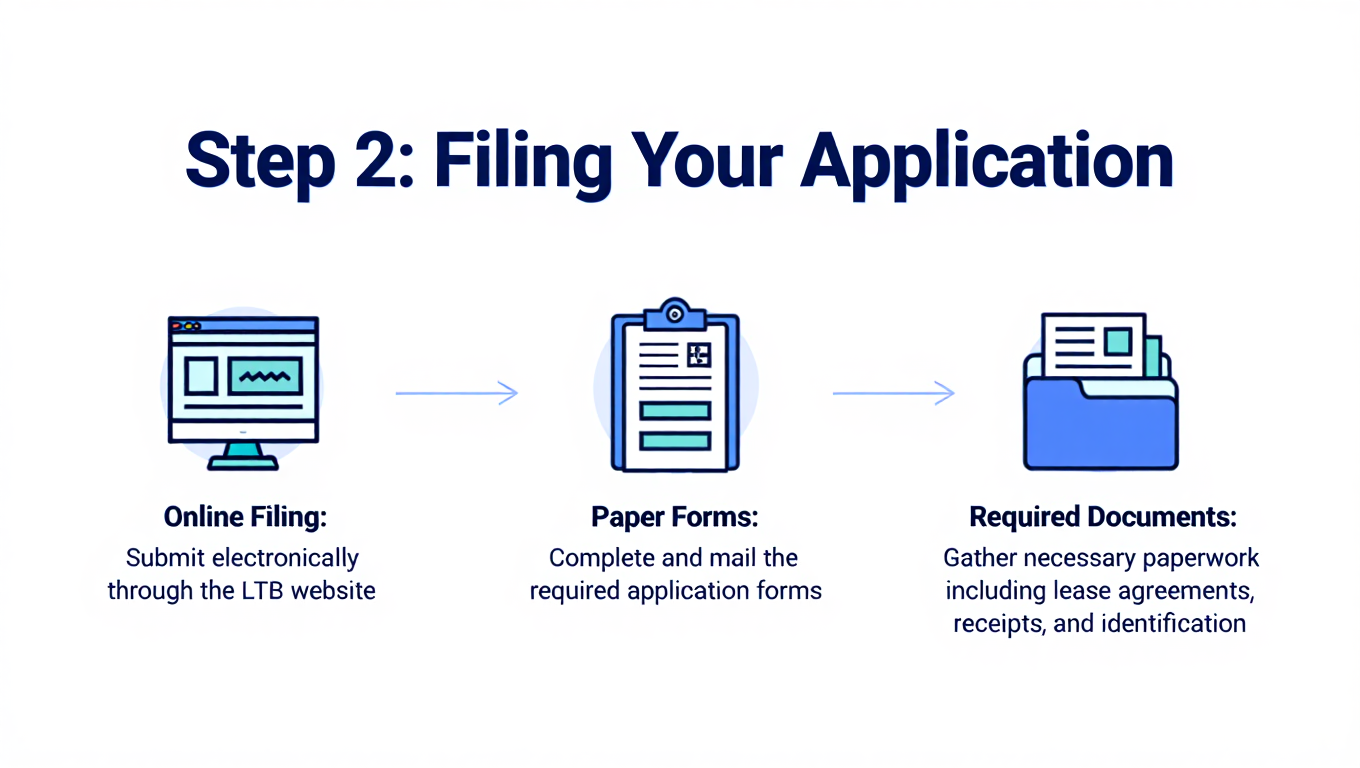
Step 2 - Filing an Application with the Landlord and Tenant Board - How To Evict A Tenant In Ontario - 001

If the tenant does not move out or fix the problem within the notice period, you then apply to the LTB for a hearing.

  • File the appropriate application (e.g., L1 for non-payment, L2 for eviction for other reasons).
  • Pay the filing fee (currently about $201 online).
  • Submit a copy of the notice served.

The LTB will schedule a hearing, usually several weeks or months later.

Step 3: Preparing for the Hearing To Evict a Tenant in Ontario

This is where many landlords fail. You must bring evidence, not just accusations. The Board will dismiss cases if your paperwork or proof is weak.

Gather:

  • Copies of the lease.
  • Rent ledger or payment history.
  • Photographs or video of damage.
  • Written complaints from neighbours.
  • Copies of communication (texts, emails, letters).
  • Proof that the notice was served correctly.

If you’re claiming eviction for personal use, be prepared to testify and provide affidavits that you or your family genuinely intend to move in for at least one year.

Step 4: The Landlord and Tenant Board Hearing

The LTB hearing is like a small court proceeding.

  • You (or your property manager or lawyer) present your case.
  • The tenant has the right to defend themselves.
  • A Member (decision-maker) listens to both sides.

Step 4 - The Landlord and Tenant Board Hearing - How To Evict A Tenant In Ontario - 003

Possible outcomes:

  • Eviction order granted (with or without conditions).
  • Order to pay arrears with no eviction if the tenant agrees to catch up.
  • Dismissal if the Board finds your application invalid.

Hearings are often delayed due to LTB backlogs. Be prepared for the process to take several months.

Step 5: Enforcing an Eviction

Even if you win, you cannot change the locks yourself. Only the Sheriff’s Office can physically remove a tenant.

  • Once the LTB issues an eviction order, you file it with the Sheriff.
  • The Sheriff will serve the tenant with a notice to vacate.
  • If the tenant still does not leave, the Sheriff attends and removes them.

Changing locks, cutting off utilities, or removing belongings on your own is illegal and can expose you to damages.

How Long Does the Eviction Process Take?

Timelines vary, but as of 2025 most landlords experience:

  • 14 days: Tenant’s deadline on an N4 (non-payment).
  • 1–3 months: Waiting period for an LTB hearing.
  • 2–6 weeks: Sheriff enforcement after the eviction order.

Overall, expect 3–6 months from serving notice to regaining possession. Complex cases or appeals can take longer.

Common Mistakes Landlords Make

  • Wrong form used → automatically dismissed.
  • Improper service → notice not valid.
  • Not keeping records → no evidence to prove your case.
  • Self-help evictions → illegal and costly.
  • Assuming verbal agreements matter → the Board relies on written evidence.

Special Rules for “Own Use” and Renovations

If you evict a tenant because you or a family member will move in (N12) or for repairs/demolition (N13):

  • You must give at least 60 days’ notice.
  • You may have to pay one month’s rent compensation.
  • If you claim personal use but do not actually move in, the tenant can sue for bad-faith eviction.

Bad-faith evictions are taken seriously and can result in significant financial penalties.

Tenant Rights During the Process

Ontario law gives tenants several protections:

  • They can pay arrears before the LTB hearing to stop an eviction.
  • They can dispute your claims at the hearing.
  • They must be given proper notice periods.
  • They cannot be forced out without an LTB order.

As a landlord, respecting these rights protects you from legal problems and keeps your reputation intact.

Why Professional Management Helps

The eviction process in Ontario is time-consuming, procedural, and unforgiving of errors. At Visture, we often step in after a landlord has lost months due to mistakes.

Professional property management helps because:

  • We know which forms apply and how to serve them.
  • We maintain meticulous rent ledgers and records.
  • We represent you at the LTB with evidence prepared.
  • We handle communication with tenants in compliance with the RTA.

In many cases, tenants pay or move voluntarily when they see that a management company is involved and procedures are being followed properly.

Key Takeaways

  • Evictions in Ontario are controlled by the Residential Tenancies Act.
  • You must have legal grounds and use the correct forms.
  • Only the LTB can issue an eviction order, and only the Sheriff can enforce it.
  • Expect the process to take several months.
  • Mistakes in forms, service, or evidence can cost you time and money.
  • Consider professional management to reduce risk and stress.

Final Word from Visture

Being a property owner in Ontario means operating under strict rules. Evictions are not simple, but they are manageable with the right approach. If you’re facing a difficult tenancy, don’t risk doing it alone. At Visture, we combine legal knowledge with practical property management to protect your investment and restore peace of mind.


https://www.visture.ca/wp-content/uploads/2025/09/msedge_8RlHdVDSlt.jpg 1077 1614 Dominic https://www.visture.ca/wp-content/uploads/2021/09/logo-web.png Dominic2025-09-18 08:43:442025-09-18 08:44:42How to Evict a Tenant in Ontario: A Guide for Property Owners

Non-Resident Tax for Owners of Canadian Rental Property

14 September, 2025

What You Need to Know About Non-Resident Taxes For Owners of Rental Properties in Canada

Owning rental property in Ontario but living outside Canada comes with unique tax rules. Canada’s Income Tax Act imposes strict reporting and withholding obligations on non-resident owners. You need to understand your duties, deadlines, and options to avoid penalties and protect your returns.

Who Counts as a “Non-Resident”?

Non-resident status is not just about where you live today. The Canada Revenue Agency (CRA) looks at:

  • Primary ties: where your home, spouse, or dependents are located. 
  • Secondary ties: such as health card, driver’s licence, and bank accounts. 

If you don’t maintain significant ties in Canada—or if you reside here for fewer than 183 days a year—you are generally considered a non-resident for tax purposes.

Rule #1: 25% Withholding on Gross Rental Income (Part XIII Tax)

By default, whoever pays your rent—either your tenant or a Canadian agent (like a property manager)—must withhold 25% of your gross rental income each month and send it to CRA by the 15th day of the following month.

That remittance counts as CRA’s collection of your tax. In this case, you typically do not need to file a Canadian income tax return.

Each year, you will also receive an NR4 slip that shows the rental income received and the tax withheld. Your agent must file the NR4 information return with CRA by March 31.

Failing to remit on time leads to daily compound interest charges and penalties. Both you and the payer (tenant or agent) are jointly liable for the amounts owing.

Rule #2: Elect Section 216 to File a Return & Claim Expenses

You can choose to be taxed on your net rental income instead of gross. This option allows you to deduct expenses such as:

  • Repairs and maintenance 
  • Mortgage interest 
  • Property taxes 
  • Insurance 
  • Management fees 

To use this option:

  1. File Form NR6 before January 1 of the rental year, or before the first rent payment is due. 
  2. Include an estimate of your expected net rental income. 
  3. Once CRA approves the NR6, your agent can withhold 25% of the net income instead of gross. 
  4. At year-end, you must file a Section 216 tax return (Form T1159) by June 30 of the following year. 

​​A home in the background, a canadian flag on the house - What you need to know about non resident taxes for rental property owners - 002

This approach often reduces the tax payable. If too much was withheld, CRA will refund the difference after processing your return.

Warning: If you miss the June 30 deadline, your NR6 election is void. CRA will assess tax on your gross rent, even if you were withholding based on net.

Deadlines at a Glance

Form / Action Deadline
Monthly withholding remit 15th of the month following rent payment
NR4 slip & return filing March 31 of the following year
NR6 filing Before Jan 1 of the year or first payment
Section 216 return filing June 30 of the following year

Penalties and Risks

  • 10% penalty plus interest applies if withholding is late. 
  • Missing the Section 216 return deadline cancels your NR6 election, and you will be taxed on gross rental income with no deductions. 
  • Both you and your agent or tenant may be held liable for missed or incorrect remittances. 

Why Using a Canadian Agent Matters

When filing an NR6, you must name a Canadian agent. That agent is responsible for:

  • Withholding and remitting taxes correctly. 
  • Filing NR4 slips and the annual information return. 
  • Managing Section 216 returns and deadlines.

A home in the background, a window has text on it - What you need to know about non resident taxes for rental property owners - 003

At Visture, we regularly act as this Canadian agent. We ensure compliance, protect your cash flow, and handle the administration so you can focus on your investment.

Key Takeaways

  • Non-resident landlords must pay 25% tax on gross rent unless they file an NR6. 
  • Filing an NR6 allows tax to be withheld on net income instead. 
  • Section 216 returns must be filed by June 30 to claim expenses and confirm your election. 
  • Penalties and interest are strict for missed deadlines or late remittances. 
  • A trusted Canadian agent makes compliance easier and avoids costly mistakes. 

Final Word from Visture

Non-resident rental ownership in Ontario is rewarding but complex. Taxes are non-negotiable, and CRA does not show leniency for missed filings. By understanding the rules—and working with experienced professionals—you protect your investment, reduce risk, and keep more of your rental income.

https://www.visture.ca/wp-content/uploads/2025/09/​​A-home-in-the-background-a-canadian-flag-on-the-house-What-you-need-to-know-about-non-resident-taxes-for-rental-property-owners-001.png 832 1248 Dominic https://www.visture.ca/wp-content/uploads/2021/09/logo-web.png Dominic2025-09-14 12:21:132025-09-14 12:23:23Non-Resident Tax for Owners of Canadian Rental Property

Rent Increase Essentials: What Every Ontario Property Owner Needs to Know

10 September, 2025

Raising rent is one of the most sensitive responsibilities of being a landlord. Do it wrong and you risk tenant disputes, delays, or even legal penalties. Do it right and you protect your income while staying fully compliant with Ontario’s Residential Tenancies Act (RTA).

This guide explains the rules, notice periods, exemptions, and strategies for raising rent in Ontario—so you stay in control of your property without stepping outside the law.

Rent-Increase-Guidelines---What-Every-Ontario-Property-Owner-Needs-to-Know

  1. Who Sets the Rent Increase Guideline?

The Ontario government sets an annual rent increase guideline.

For 2025, the guideline is 2.5%. That means landlords can raise rent by no more than 2.5% on most residential units, unless they apply for special approval.

The guideline applies to units that were first occupied on or before November 15, 2018.

Units first occupied after November 15, 2018—such as new builds, basement apartments, or additions—are exempt from rent control. For those units, landlords can raise rent by any amount once every 12 months, provided proper notice is given.

  1. How Often Can You Raise Rent?

Rent can only be increased once every 12 months.

The 12-month period is measured either from the start of the tenancy or from the last legal rent increase.

Even if your unit is exempt from rent control, you must still respect the 12-month rule.

3. Serving Proper Notice

Ontario law requires at least 90 days’ written notice before a rent increase can take effect.

Use the official Form N1: Notice of Rent Increase.

The notice must include:

Current rent amount

New rent amount

Percentage increase

Date the increase takes effect

Statement of whether the increase is within the guideline or above it

If the notice is incomplete or served incorrectly, the rent increase is invalid, even if the percentage is correct.

  1. Above-Guideline Increases (AGI)

In certain circumstances, landlords may apply to the Landlord and Tenant Board (LTB) to raise rent by more than the guideline. This is called an Above-Guideline Increase (AGI).

When AGI Can Apply

Capital expenditures: Significant repairs or upgrades that extend the life of the property (e.g., new roof, heating system replacement).

Extraordinary increases in municipal taxes or utilities: Increases that are well above normal inflation.

Security services: New or more expensive security measures such as 24-hour guards.

Limits

The LTB generally caps AGIs at 3% above the guideline per year, for up to three years.

For extraordinary municipal tax increases, there is no cap.

Process

Give tenants 90-day notice of the proposed increase.

File an AGI application with the LTB.

Attend a hearing (phone, video, or written process).

The LTB decides whether to approve, reduce, or deny the request.

5. How to Calculate Rent Increases

Example 1: Within the Guideline

Current rent: $1,500

Guideline: 2.5%

Increase: $37.50

New rent: $1,537.50

Example 2: Above Guideline with Approval

Current rent: $1,500

Guideline: 2.5%

Approved AGI: 3% additional

Total increase: 5.5% = $82.50

New rent: $1,582.50

6. Exempt Units

If your property qualifies as exempt (occupied for the first time after November 15, 2018):

You may set any rent amount at the beginning of the tenancy.

You may increase rent by any amount, but only once every 12 months.

You must still give 90-day written notice using Form N1 or equivalent.

7. Common Mistakes Landlords Make

Raising rent too soon: Forgetting about the 12-month rule.

Improper notice: Using the wrong form or not providing all details.

Failing to document exemption: If the unit is exempt, keep building permits, occupancy certificates, or other proof.

Attempting an AGI without evidence: You need receipts, invoices, and records for capital expenditures or tax increases.

8. Tenant Rights to Challenge Increases

Tenants can dispute rent increases at the LTB if:

The notice was invalid.

The increase was above guideline without proper approval.

The landlord claimed AGI but cannot prove the expenses.

If a tenant challenges the increase, the landlord must show evidence that the increase was valid under the RTA.

  1. Strategies for Property Owners

Plan increases annually: Even if you don’t need the extra rent today, small increases each year are easier for tenants to absorb and protect your income long-term.

Document everything: Notices, receipts, and proof of exemption should always be on file.

Budget for capital expenses: If you anticipate large repairs, plan ahead so you can justify AGIs properly.

Stay professional: Rent increases are sensitive. A clear explanation and professional communication reduce disputes.

10. Quick Reference Table

Rule Requirement
Frequency Maximum once every 12 months
Notice 90 days’ written notice (Form N1)
Guideline for 2025 2.5%
Exempt Units Occupied after Nov 15, 2018 – not subject to cap
Above Guideline Increase Requires LTB approval; up to 3% above guideline/year
Documentation Lease, notices, receipts, tax records, AGI evidence

Final Word from Visture

Raising rent in Ontario isn’t complicated, but it is structured. Stick to the guideline, respect the 12-month and 90-day rules, and keep your paperwork tight. If you need an AGI, be prepared with strong evidence.

At Visture, we help property owners apply the rules correctly. From drafting notices to representing landlords at the LTB, we manage the process so you don’t risk delays or disputes.


https://www.visture.ca/wp-content/uploads/2025/09/Rent-Increase-Guidelines-What-Every-Ontario-Property-Owner-Needs-to-Know-002-scaled.jpg 1708 2560 Dominic https://www.visture.ca/wp-content/uploads/2021/09/logo-web.png Dominic2025-09-10 17:58:532025-09-10 17:58:53Rent Increase Essentials: What Every Ontario Property Owner Needs to Know

Investing in Canadian Real Estate as a Foreigner

1 September, 2025

Investing in Canadian Real Estate as a Foreigner: What Property Owners Should Know

Canada’s real estate market attracts global attention, but foreign investors face unique restrictions, taxes, and compliance rules. If you’re considering purchasing property in Canada as a non-resident, you need to understand what is possible, what is prohibited, and how to structure your investment to stay compliant.

1. Federal Ban on Residential Purchases

  • Since January 1, 2023, a federal law prohibits non-Canadians from buying most residential property in Canada.

  • This ban has been extended until January 1, 2027.

  • “Residential property” means buildings with up to three dwelling units, including detached houses, semi-detached houses, row houses, condominium units, and similar structures.

  • The ban mainly affects urban areas (census metropolitan and agglomeration zones). Properties in smaller rural or recreational areas are generally not restricted.

  • Exceptions exist:

    • Large buildings with four or more units are not covered.

    • Some categories of foreign nationals (such as work permit holders meeting certain conditions) may be exempt.

    • Commercial property and land zoned for development are not restricted.

2. Provincial and Municipal Taxes

Even if the federal ban does not apply, foreign buyers must account for significant additional taxes:

  • Ontario Non-Resident Speculation Tax (NRST): 25% of the purchase price of certain residential properties in Ontario.

  • Toronto Municipal Non-Resident Speculation Tax (MNRST): An additional 10% applies within the City of Toronto.

  • These taxes apply on top of regular land transfer taxes, legal fees, and closing costs.

3. Commercial and Rural Properties

The ban targets residential housing, not all real estate. Foreign investors can still:

  • Purchase commercial properties such as retail, office, or industrial buildings.

  • Buy land for development or farmland, depending on provincial restrictions.

  • Acquire multi-unit residential buildings with four or more units, which are excluded from the ban.

Commercial and Rural Properties - Buy Rural Properties in Canada - 001

These opportunities remain open, though taxes and financing conditions still apply.

4. Ownership Structures for Foreign Investors

Foreign investors often use structured ownership arrangements to meet Canadian requirements:

  • Corporations: Setting up a Canadian subsidiary or registering extra-provincially.

  • Partnerships: Joint ventures with Canadian investors, limited partnerships, or LLPs.

  • Trusts: Bare trusts or discretionary trusts where a Canadian trustee holds legal title.

Each option carries different liability, tax, and reporting obligations. Legal advice is strongly recommended before choosing a structure.

5. Investment Canada Act (ICA)

Significant foreign investments in Canadian businesses—including real estate businesses—may be subject to review under the Investment Canada Act. The federal government can assess whether an investment provides a net benefit to Canada or raises national security concerns. While this rarely applies to individual property purchases, it can apply to large-scale acquisitions by foreign corporations.

6. Taxation of Non-Resident Owners

Even when ownership is allowed, foreign investors face tax obligations:

  • Rental income is taxable in Canada. Non-residents must remit withholding tax on gross rent unless they elect to be taxed on net income (Section 216 filing).

  • Capital gains tax applies when the property is sold. Non-residents must obtain clearance certificates from the Canada Revenue Agency (CRA), and part of the sale proceeds may be withheld at closing.

  • Annual compliance includes filing the proper Canadian tax returns, remitting tax on time, and meeting CRA deadlines.

Failure to follow tax rules can result in penalties, interest charges, and problems completing a sale.

7. Market Impact and Context

Foreign ownership has historically represented a small percentage of Canadian real estate. However, in major cities like Toronto and Vancouver, it has drawn attention due to perceptions of price impact. This contributed to both the federal ownership ban and additional provincial/municipal taxes targeting foreign buyers.

For investors, this means navigating not just market fundamentals but also political and regulatory environments.

Alternatives To Direct Ownership For Foreigners Investing in Real Estate in Canada - 001

8. Alternatives to Direct Ownership

If buying residential property directly is not possible due to the ban or taxes, foreign investors can still access Canadian real estate returns through indirect approaches:

  • Mortgage Investment Corporations (MICs): Pooled funds that invest in mortgages, paying investors a share of the income.

  • Real Estate Investment Trusts (REITs): Publicly traded or private trusts that own income-producing properties across Canada.

  • Partnership with Canadian investors: Joint ventures where the Canadian party takes legal title while the foreign partner contributes capital.

These routes avoid ownership restrictions while providing exposure to the Canadian property market.

9. Quick Reference Table

Category Key Rules and Takeaways
Federal Residential Ban In place until January 1, 2027; applies to residential properties with up to 3 units in urban areas
Exempt Properties Multi-unit (4+), commercial, and rural or development-zoned land
Ontario NRST 25% additional tax on certain residential purchases by non-residents
Toronto MNRST 10% additional municipal tax on foreign buyers
Ownership Structures Options include corporations, partnerships, and trusts
Tax Obligations Rental income, capital gains, and annual CRA compliance required
ICA Review Applies to large or sensitive business investments
Alternatives MICs, REITs, or joint ventures with Canadian owners

Final Word from Visture

Foreign investment in Canadian real estate is no longer straightforward. Federal restrictions, provincial and municipal taxes, and ongoing compliance requirements mean you must be informed before acting.

If you’re considering an investment:

  • Confirm whether the property type is restricted or exempt.

  • Calculate additional taxes and closing costs.

  • Decide on the most effective ownership structure.

  • Plan for ongoing tax compliance as a non-resident.

  • Explore indirect investment options if direct ownership isn’t possible.

At Visture, we guide property investors through every stage—compliance, structuring, management, and tax planning—so you can invest confidently and within the law.

https://www.visture.ca/wp-content/uploads/2025/09/msedge_egDfM0XDDV.png 289 443 Dominic https://www.visture.ca/wp-content/uploads/2021/09/logo-web.png Dominic2025-09-01 18:13:342025-09-01 18:13:34Investing in Canadian Real Estate as a Foreigner

Get Your FREE
Property Management
Short Course

Get Course Now
Search Search

Recent Posts

  • 6 ADU 1287 Cartier Kitchen
    Is an ADU Worth It in Peterborough? ROI, Payback, and the Numbers Homeowners Should Check30 June, 2026 - 9:00 am
  • Real detached two-bedroom coach home (ADU) built by Visture Property Group in a Peterborough backyard, shown at dusk with patio seating
    What Does It Cost to Build an ADU in Peterborough?25 June, 2026 - 2:47 pm
  • 8 ADU 1287 Cartier Living Room
    How Much Can an ADU Rent for in Peterborough?8 June, 2026 - 2:20 pm
  • Peterborough ADU Rules Explained: What Homeowners Can Actually Build in 2026
    Peterborough ADU Rules Explained: What Homeowners Can Actually Build in 202628 May, 2026 - 5:55 pm
  • PPP Before and After
    Beat Rising Renovation Costs with Priority Pricing9 May, 2026 - 3:11 pm
  • Peterborough ontario home
    No HST + Ontario Development Charges Cut 50%: What It Means for You30 March, 2026 - 2:25 pm
  • Convert Your Peterborough Home Into a Duplex or Triplex -Zoning Permits and more - 001
    How to Convert Your Peterborough Home Into a Duplex or Triplex: Zoning, Costs, and the Investment Case30 March, 2026 - 4:12 am
  • Building a Coach Home in Peterborough - A small ADU in a backyard of a home in Peterborough - 001
    Building a Coach Home in Peterborough: Costs, Permits, Timelines, and How to Turn Your Backyard Into $2,200+/Month16 March, 2026 - 10:00 am

Oshawa | Peterborough | Lindsay | Kawartha Area | Orillia | Barrie | Huntsville | Ontario

  • vpm@visture.ca
  • 705-998-2017
  • 552 Armour Rd. Peterborough ON Canada

Visture Awards

© 2025 Visture Property Group LLP | Privacy Policy

Scroll to top Scroll to top Scroll to top